
Energy Roundup: October 16, 2026


Author: Liam Gibson, Kurtis Yan
10/16/2026 · 7 min read
 shutterstock
This is the first iteration of the Caspian Policy Center’s Energy Roundup, which will be published biweekly. This edition is a deep dive look into Georgia’s grid system and its vulnerabilities, as it seeks to become a regional energy exporter and facilitator of broader connectivity. Also, in the news, Tajikistan’s parliament ratified a $300M grant from the World Bank for Rogun Dam, and Azerbaijan and major energy firms signed new cooperation agreements. Recent articles published at CPC cover Armenia’s nuclear question, Turkmenistan’s blackout at the end of August, and an assessment of India’s energy cooperation with the Caspian Region.
Deep Dive: Examining Georgia’s Grid and Energy Dependencies
By Liam Gibson and Kurtis Yan
Georgia has suffered from three major blackouts on July 23-24, July 25, and August 5. While information is scarce, the August 5 blackout was attributed to technical failures and testing at Enguri Hydroelectric Power Plant (HPP), the country’s vital hydropower engine at the center of the whole grid. Georgia relies on hydropower in the summer and aims to become an electricity exporter for the region. However, how feasible is this goal if blackouts persist and electricity imports continue to rise?
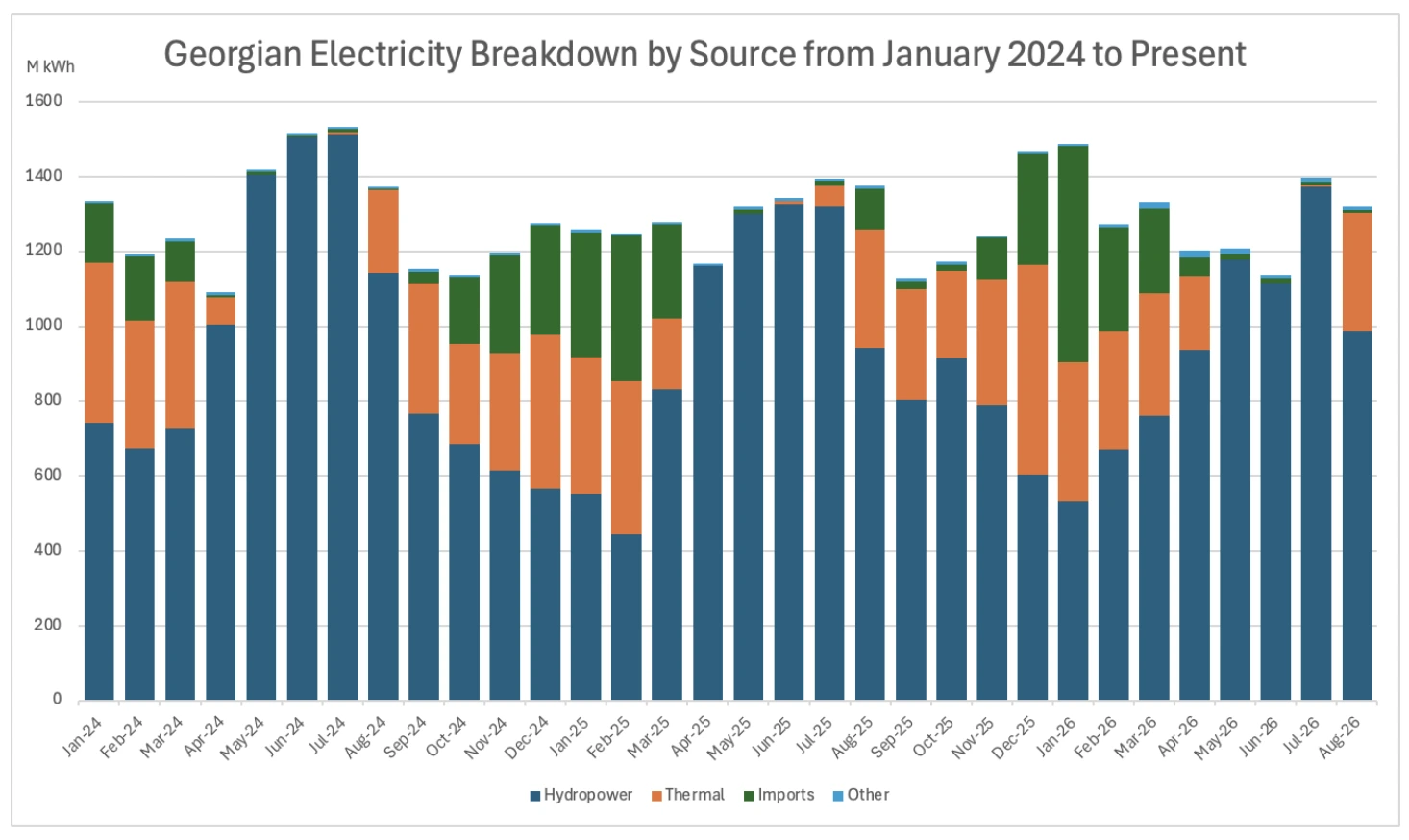 Source: Georgia’s Electricity Market Operator (ESCO).
Distribution of Georgia’s power generation by source every month from January, 2024, to present.
Nearly 80 percent of Georgia’s electricity comes hydropower year-round, though hydropower plants generate nearly all power in the warm-weather months. In the winter, thermal power plants and electricity imports play a greater role in meeting demand.
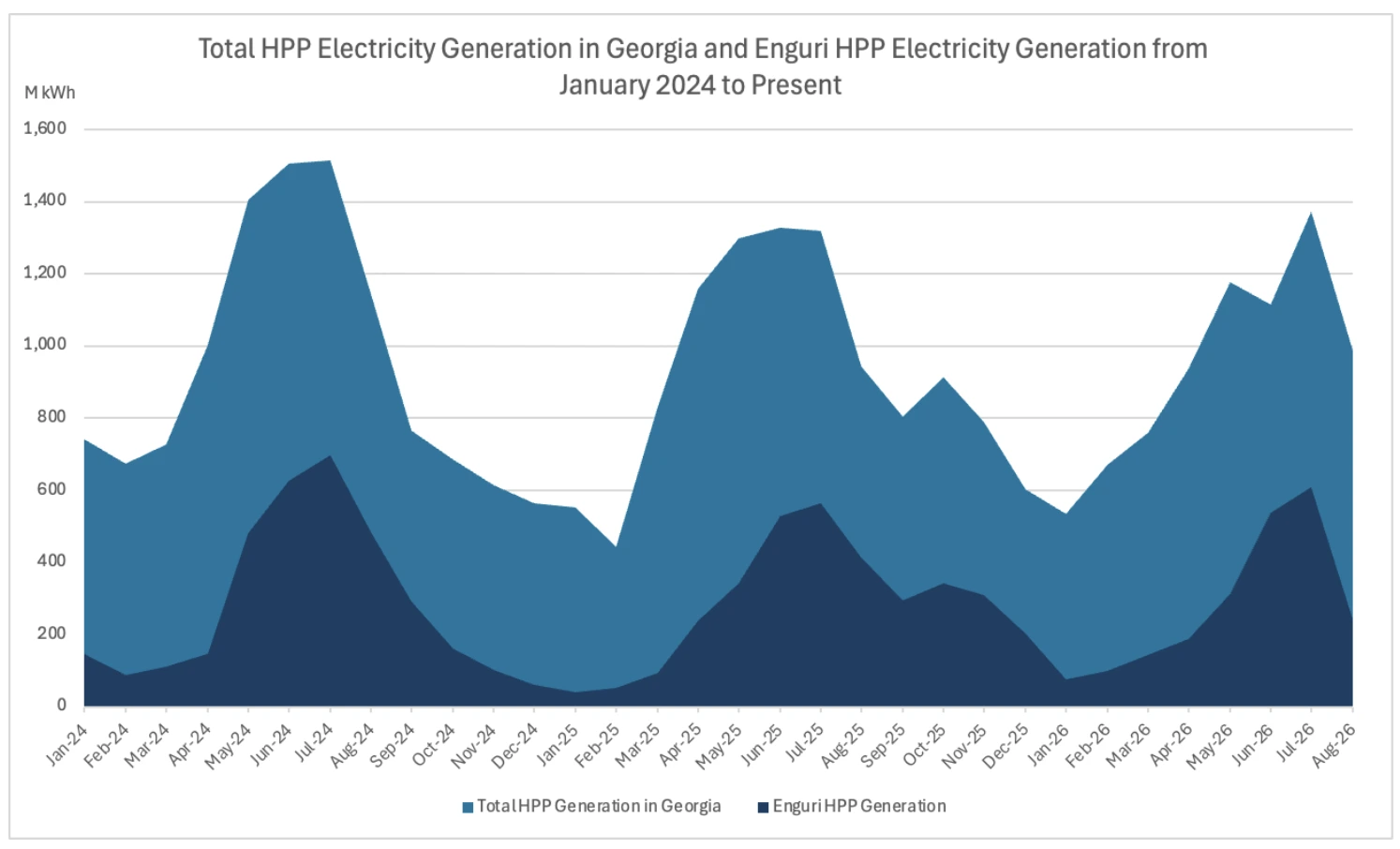 Source: Georgia’s Electricity Market Operator (ESCO).
Power generation from Enguri HPP overlaid with Georgia’s total hydroelectric power generation from January, 2024, to present.
A single HPP, Enguri HPP, supplies roughly 40 percent of Georgia’s total electricity during the summer. Its generation dwarfs that of any other year-round or seasonal HPP in Georgia. Enguri was originally planned as the middle of a larger cascade of hydroelectric dams and HPPs, but the larger project was abandoned after the Soviet collapse. As a result, Georgia is dangerously dependent on Enguri for electricity, and if it is disrupted, the entire Georgian grid may follow. This represents a failure to meet the N-1 criterion, a standard used to measure an electrical grid’s resilience, indicating whether a system can continue functioning if one critical component goes down.
Despite the grid’s systemic issues, domestic demand continues to rise in households, industry, and the cryptocurrency sector. Meanwhile, Tbilisi hopes to become a prominent energy exporter and facilitator across the South Caucasus. Recent efforts to improve regional connectivity have raised the question of interstate grid integration, but such initiatives will require considerable investment and political will to overcome technical obstacles.
Read the full analysis here.
Energy in the News
1. Russia Sharply Increases Diesel Shipments to Central Asia Despite Broader Export Restrictions
Russian diesel exports to Kazakhstan, Kyrgyzstan, and Tajikistan more than doubled in August from the previous month, exceeding 370,000 metric tons across Central Asia and neighboring Mongolia. The increase came as Russia maintained restrictions on fuel exports to most foreign markets while permitting shipments to countries covered by intergovernmental arrangements. The surge reflects Central Asia’s continuing dependence on Russian fuel supplies and Moscow’s ability to use energy trade selectively despite domestic production pressures caused, in part, by Ukrainian attacks on Russian refineries.
Source: Reuters
2. Major Cooperation Agreements Signed Between Azerbaijan and International Firms
Azerbaijan and its state-owned enterprises signed a number of strategic frameworks and Memoranda of Understanding (MoUs) with international companies on the sidelines of the second Azerbaijan International Investment Forum on September 26. These included a “final investment decision” between SOCAR, TotalEnergies, and XRG regarding additional drilling and new processing infrastructure at the Absheron gas-condensate field. Production is expected to begin in 2029 and reach approximately 17 million cubic meters of gas and 47,000 barrels of condensate per day. A production sharing agreement (PSA) between SOCAR and ExxonMobil was also signed on exploration of the Middle Kura basin.
Source: president.az, Euronews
3. Kazakhstan and South Korea Agree to Increase Energy Cooperation
Officials from Kazakhstan and South Korea signed several Memoranda of Understanding (MoUs) on energy cooperation, including nuclear fuel research and to facilitate Kazakh crude oil exports to South Korea. They also agreed to continue the development of a $6B gas processing plant in Karachaganak, Kazakhstan, as well as a separate MoU on a green ammonia project. The MoUs were signed on the sidelines of the inaugural Central Asia-South Korea heads of state summit in Seoul.
Source: Times of Central Asia, Business Korea
4. Tajikistan Approves $300M Grant from World Bank for Rogun Dam
The country's parliament ratified the latest grant package from the World Bank’s International Development Association (IDA) on October 1, bringing total institutional financing to $650M. Rogun Dam would be Tajikistan’s largest hydropower project and is expected to reach full operational capacity by 2033. Construction has yielded 190 meters of the projected 335 meters in height.
Source: Times of Central Asia
5. Tajikistan Receives Shipments of Iranian Oil
Iranian oil and petroleum have been exported to Tajikistan for the last two months, although the volume and frequency of the shipments, as well as the shipment’s route, are unclear. While necessary, Tajikistan’s imports conflict with the U.S. Operation Economic Outcast that seeks to isolate the Iranian economy. As a consequence, Tajikistan could face sanctions for ongoing trade with Iran. At the same time, Tajikistan’s purchase of Iranian oil and petroleum will allow the small country to ease its dependence on Russia.
Source: Oil Price, US Treasury
Recent Analysis in Brief
Yerevan’s Nuclear Question Might No Longer Have an American Answer
By Kurtis Yan
Armenia’s nuclear energy diplomacy sits at the spotlight of renewed U.S. attention to the South Caucasus. After all, the U.S. was one of five potential partners to help construct a new nuclear power plant (NPP) to replace its aging Metsamor nuclear power plant (NPP), maintained by Russian state nuclear company Rosatom.
While much energy and momentum was growing towards the potential of small modular reactor (SMR) cooperation between Yerevan and Washington, Prime Minister Nikol Pashinyan cast doubt on whether an SMR can meet Armenia’s growing energy demand. As the country constructs new AI data centers, he suggested that a traditional NPP could be necessary. And in the coming months, this may reaffirm Russia’s involvement in its nuclear industry in the long run.
Read the full article here.
Blackouts in Turkmenistan Reveal Vulnerabilities in Power Infrastructure
By Liam Gibson
 Source: Shutterstock
A large-scale blackout hit Turkmenistan and parts of neighboring Afghanistan on August 30, exposing the challenges faced by the country’s relatively isolated grid in a region with increasing energy needs.
This was the first widespread blackout in the country since 2020. Unverified sources claimed that the blackout was caused by an explosion at Mary State Power Station, Turkmenistan’s largest power plant with a generating capacity of 3,000 MW. Turkmenistan’s grid contrasts regional trends of trans-border energy integration, which can improve a grid’s flexibility and resilience but does not guarantee immunity to outages.
Investments in energy security and diversification are growing across Central Asia, including in Turkmenistan, as countries grapple with seasonal supply and demand disparities, rising temperatures, and energy-intensive projects.
Read the full article here.
Country Spotlight: Exploring India’s Role as an Energy Market for the Caspian Region
By Kurtis Yan
New Delhi continues to expand cooperation with its existing network of energy suppliers in the Caspian Region, though improving upon existing energy cooperation will require interregional coordination to enhance North-South connectivity.
India has intensified its search for reliable nuclear fuel and hydrocarbon supplies to meet growing energy consumption. This brought Indian Prime Minister Narendra Modi to Tashkent in September. India and Uzbekistan are set to finalize a new contract for uranium supplies, building off previous deals between the states for nuclear fuel. India has also increased its oil imports from Azerbaijan since 2022, although these volumes have declined since 2025.
While there is political will to expand interregional commerce, the necessary logistical infrastructure and geopolitical stability are lacking. Until the further development of the International North South Transport Corridor (INSTC) and the resolution of conflict in the Middle East, uranium and hydrocarbon shipments to India will likely remain limited to their current capacity.
Read the full article here.
