
Energy Roundup: November 13, 2026
Recent Articles


Author: Caspian Policy Center
11/16/2026 · 7 min read
 Petronas
In this iteration of CPC’s Energy Roundup, we analyze Malaysia’s energy footprint in the Caspian region, spearheaded by Petronas’ exploration and investment in Turkmenistan. In the news, Kazakhstan maps out initiatives to secure its domestic nuclear fuel cycle, Uzbekistan looks to China for fuel, and Azerbaijan’s SOCAR acquires a stake in a U.S. natural gas project. A recent publication from CPC also highlights the environmental and economic risks of fugitive and preventable methane emissions, most indicative in Turkmenistan.
Deep Dive: Malaysia’s Energy Footprint in Turkmenistan and the Greater Caspian Region
During the 31st International Conference and Exhibition Oil and Gas of Turkmenistan (OGT 2026), Malaysia’s Petronas reaffirmed its commitment to offshore exploration and production in the Caspian Basin, with an expectation of new drilling at the end of the year.
The oil and gas state-owned enterprise (SOE) established a footprint in Turkmenistan in 1996, becoming deeply invested in the country’s energy sector. Petronas has historically injected most of its investment into Block 1, investing around $12B into Turkmenistan since 1996. It received the PSA contract for Block 1 in 1996, becoming the first company awarded a license by Turkmenistan. Oil extraction began in 2006 at 10,000 barrels a day, while gas production began in 2011 and currently sits at roughly 400 million cubic feet a day, or 4.1 billion cubic meters a year.
In 2025, Petronas signed a PSA with Abu Dhabi National Oil Company’s (ADNOC) XRG and Khazarnebit to boost production at Block 1’s gas and condensate fields. Petronas Carigali has also received a 25-year PSA extension for Block 1 into 2050. That same year, Petronas Carigali signed a Memorandum of Understanding (MoU) on upstream technical exchanges with Dragon Oil, a subsidiary of Emirates National Oil Company (ENOC).
Although most active in Turkmenistan by a large margin, Malaysia’s energy engagement has notably reached other parts of the Caspian Region. Discussions on upstream exploration, investment, and downstream production took place with Uzbekistan on the sidelines of the OGT 2026. Malaysian officials and companies have also signed MoUs and deals on green energy development in the Caspian Region, while Malaysia has raised its coal imports from Kazakhstan.
Beyond energy, Kuala Lumpur has strengthened its relations with the region through other sectors, transforming the connection into a more holistic relationship. Trade turnover from Malaysian exports has grown, officials have signed new agreements on tourism, high-level diplomatic visits are commonplace, and a new emphasis has been placed on Islamic ties and the halal industry.
Read the full article here
Energy in the News
Source: Akorda
1. Kazakhstan Looking to Build Strategic Nuclear Storage Reserve by 2050
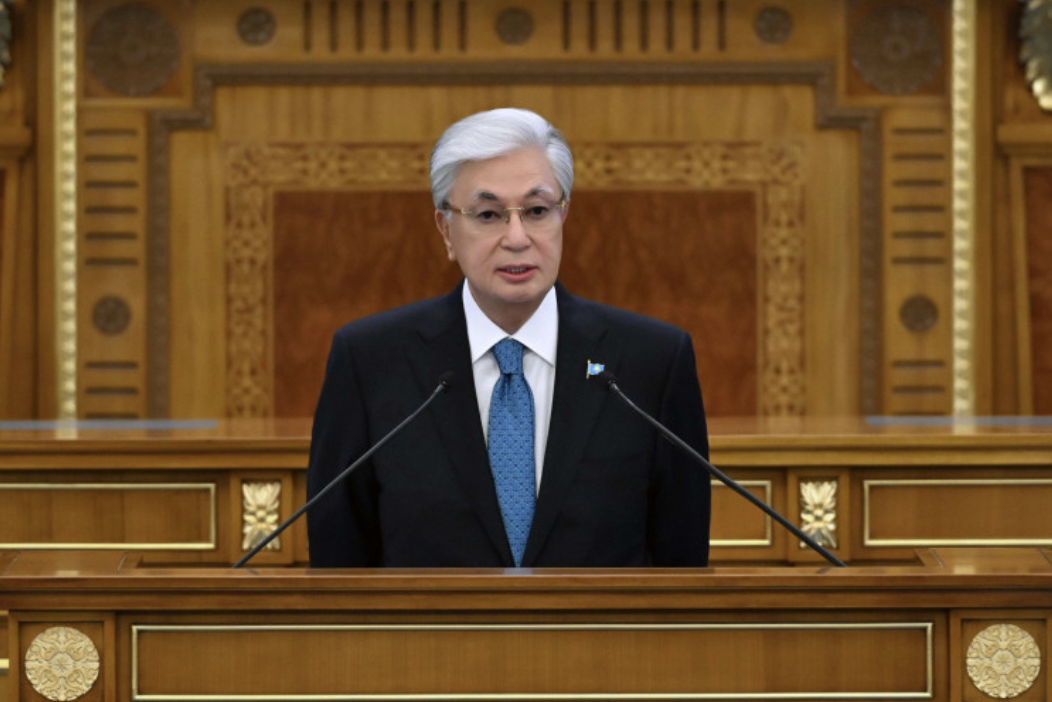
Kazakhstan’s state nuclear company Kazatomprom is reviewing six areas for nuclear reserves that could supplement Kazakhstan’s planned nuclear power plants for 100 years, Kazakhstan’s President Kassym-Jomart Tokayev said during his November 3 address to the nation. Tokayev stated that the country is aiming to have at least 150,000 tons of uranium in storage by 2050, with a mix of nuclear fuel and physical stockpiles of unprocessed uranium.
Source: World Nuclear News
2. Small Modular Reactor Training Simulator Opens in Almaty
Kazakhstan opened a training simulator for the SMR-300 small modular reactor at the Institute of Nuclear Physics in Almaty on October 30. The simulator will support the training of nuclear energy specialists. The complex falls under the U.S. Department of State’s Foundational Infrastructure for Responsible Use of Small Modular Reactor Technology (FIRST) program, of which Kazakhstan became the first Central Asian member in 2022.
Source: The Astana Times
3. Uzbekistan Seeks Chinese Fuel Supplies Amid Decline in Russian Imports
Uzbekistan's state-owned energy company, Uzbekneftegaz, is reportedly negotiating with Chinese companies, including PetroChina, to secure alternative supplies of gasoline, diesel, and crude oil following a sharp decline in imports from Russia. Russia, which previously accounted for approximately 85–90 percent of Uzbekistan's gasoline imports, reportedly saw its monthly deliveries fall from 141.8 million liters in April to 11.4 million liters in August, partly due to disruptions at Russian refineries caused by Ukrainian drone strikes. Uzbekistan is also considering plans to double the annual processing capacity of its Bukhara refinery to strengthen domestic fuel production.
Source: Gazeta.uz
4. Kazakhstan Requests Resumption of Oil Exports to Germany via Druzhba Pipeline
Kazakhstan has formally requested that Russia resume the transit of Kazakh oil to Germany through the Druzhba pipeline, following a six-month suspension that began in May. On November 4, Kazakh Energy Minister Yerlan Akkenzhenov confirmed that Kazakhstan has the technical capacity to resume shipments and is awaiting Russia's response. Kazakhstan exported 2.1 million tons of crude oil to Germany's Schwedt refinery through the pipeline in 2025, with plans to increase deliveries to approximately 3 million tons in 2026.
Source: The Times of Central Asia
5. SOCAR Acquires $1.65 Billion Stake in U.S. Company Comstock
Azerbaijan’s state oil company SOCAR acquired a $1.65 billion stake in Comstock, an American natural gas company. The agreement, signed on November 4 but awaiting government approval and other finalizations, would give SOCAR a 20 percent stake in the upstream assets of the Legacy Haynesville project and a 15 percent stake in the upstream assets of the Western Haynesville project. SOCAR would also acquire a 15 percent share of Comstock’s 73 percent stake in Pinnacle Gas Services LLC.
Source: OC Media
6. Water Tank Rupture Occurs at Rogun Dam
A water tank ruptured on October 21 inside the construction tunnel system of Rogun Dam, Tajikistan’s largest hydropower project. Tajik media reported no injuries as a result of the incident, though reporting by Radio Ozodi claimed that at least five workers were injured, according to witnesses. During the time of the accident, subcontractors from Chinese enterprise Sino Hydro were working in the tunnel.
Source: Eurasianet, Asia Plus
7. $400 Million China Development Bank Loan to Fund New Pipelines in Kazakhstan
KazMunayGas (KMG), KMG PetroChem LLP, and China Development Bank have signed a loan agreement for up to $400 million to finance the first main ethane and propane pipelines in Kazakhstan, which are already under construction by a China-led consortium. The 15-year credit line will support the two pipelines’ construction in the Atyrau region. Each pipeline will stretch 210 km along the technical corridor between Tengiz Gas Separation Complex and Karabatan. The ethane pipeline’s 1.6-million-ton annual capacity will go to a polyethylene plant currently under construction, while the propane pipeline’s 1.1-million-ton annual capacity will go to an existing polypropylene plant.
Source: Trend
Recent Short Analyses
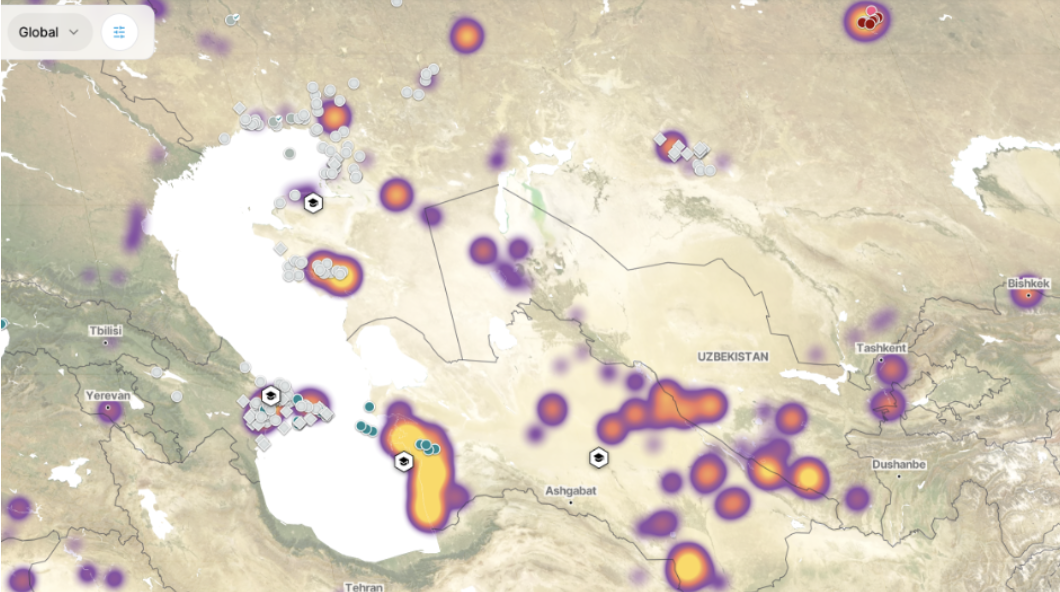 Screen capture of methane leaks in Turkmenistan and the rest of the Caspian Region. Source: UNEP MARS
By Kurtis Yan
Though not the largest methane emitter by volume in the Caspian region, Turkmenistan has also been cited for the highest number of super-emitter methane leaks in the world. The most recent data from the United Nations Environment Programme’s (UNEP) Methane Alert and Response System (MARS), from August 2025 to end of July 2026, recorded over 180 methane leaks from Turkmenistan.
Many of these leaks are fugitive, or unintentional plumes, diverging from typical greenhouse gas emissions that come from industrial activity. Methane is the second most prevalent greenhouse gas in the atmosphere, and while it dissipates at a faster rate than carbon dioxide (CO2), it traps 80 times more heat than CO2 at the same volume over a 20-year period.
Beyond environmental impact, fugitive methane emissions from preventable gas leaks reduce Turkmenistan’s actual profits coming from production and sales. Limiting methane emissions in industry could also prove important as the country looks to export gas to Europe.
Despite the high quantity of emissions, Turkmenistan appears to be taking some action to resolve this issue, both verbally and in action by plugging leaks, though more may be required to address the true scale of the problem.
Read the full story here

