Country Spotlight: Exploring India’s Role as an Energy Market for the Caspian Region
Recent Articles
Author: Kurtis Yan
09/29/2026
 President.Uz
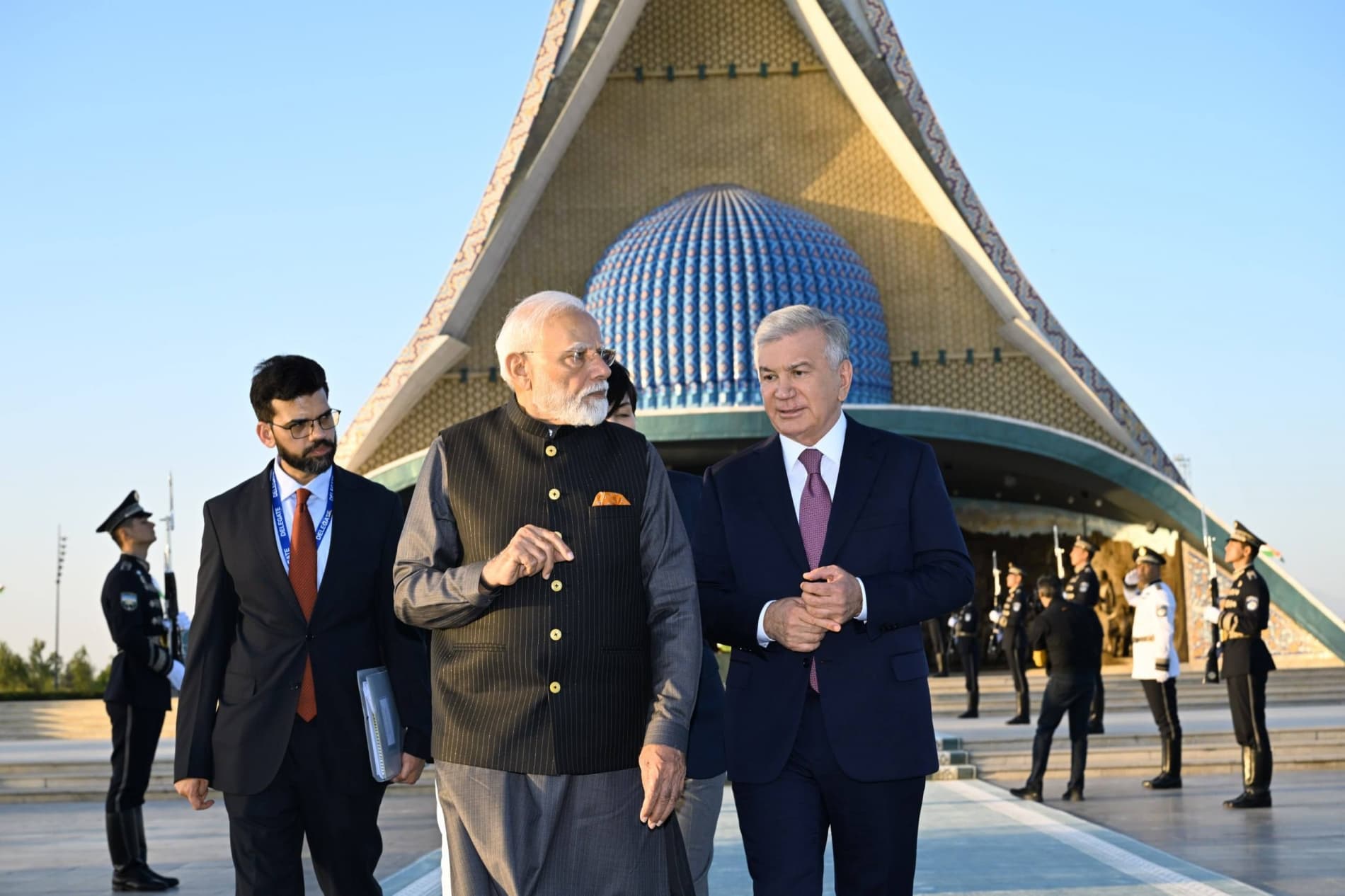
Prior to his participation in the recent Shanghai Cooperation Organization’s (SCO) summit in Bishkek, Kyrgyzstan, India’s Prime Minister Narendra Modi visited his Uzbek counterpart Shavkat Mirziyoyev in Tashkent. There, the two leaders discussed details to finalize the renewal of India’s current uranium supply contract with Uzbekistan. India’s nuclear sector and industrial ambitions are increasing New Delhi’s incentive to seek consistent nuclear fuel supplies abroad and cost-competitive imports of hydrocarbons.
Can the Caspian region’s potential help improve India’s energy security? Current energy trade is small, but India has emerged as a key economic demand hub for global energy producers. At the same time, the Caspian region’s integration into India’s calculus is highly dependent on the resilience of existing and prospective supply corridors.
India as a Uranium Consumer
Modi’s talks with Mirziyoyev yielded optimism in bilateral trade and economic cooperation going forward. The two leaders set a goal of $5B in annual trade turnover by 2030, and energy commodities may play an important part in that mix. India first signed a supply contract with Uzbekistan back in 2019, promising up to 1,100 tons of uranium concentrate, or yellowcake, to India by 2026. Finalization of the renewed contract is expected to come this year, though no exact volume or value has been assigned as of yet. Meanwhile, officials during the visit signed a memorandum of understanding (MoU) to expand critical minerals cooperation, encouraging Indian companies to explore and develop Uzbekistan’s deposits.
India has a longer nuclear history with Kazakhstan, dating back to a 2009 MoU on nuclear cooperation between Kazatomprom and India's Nuclear Power Corporation. A concrete framework on supplies was signed in 2011, paving the way for 2,100 tons of uranium to be supplied to India by 2015, followed by another agreement for 5,000 additional tons by 2019. After a brief pause, India’s Department of Atomic Energy signed a nuclear concentrate supply deal worth $4B with Kazatomprom.
New Delhi has expressed its interest in vastly scaling up its civil nuclear program in coming years. With current capacity at 8.78 GW (gigawatts) across 24 nuclear reactors, the country aims to reach 22.38 GW by 2031, followed by 100 GW of nuclear energy output by 2047. To supplement this expected level of production, India will require a steady stream of nuclear concentrate to feed its enrichment and processing facilities. As such, it will likely continue to court Kazakhstan and Uzbekistan to safeguard its supply of uranium and maintain its diverse list of suppliers and nuclear engineering partners, which also includes Australia, Canada, and Russia.
High Hydrocarbon Demand but Limited Diversification
India imports over 83 percent of its crude oil supply from Russia and the Gulf states. Russia continues to sell oil to India at discounted rates, but the ongoing U.S.-Iran War has severely stifled oil shipments out of the Strait of Hormuz. As the world’s third largest hydrocarbon consumer with the fastest growth in oil consumption, India may seek to diversify its supply of cost-effective hydrocarbons, though current business with the Caspian region is limited.
Azerbaijan is India’s primary oil supplier from the region. Shipments from the country typically flow from the Baku-Tbilisi-Ceyhan (BTC) pipeline, which then reach India by sea from the Ceyhan port in Türkiye. Oil exports to India grew substantially following the start of the Russia-Ukraine War, with a 12-month peak just over 2 million tons of crude oil at roughly $1.23B in 2023. This accounted for 7.8 percent of Azerbaijan’s total oil exports. After exceeding 1.1 million tons, valued at $730M, in 2024, a pricing dispute arose with Azerbaijan. As such, India’s imports from the country declined to just $167M in crude oil in 2025.
Moreover, ONGC Videsh Ltd (OVL), part of India’s Oil and Natural Gas Corporation public enterprise, acquired roughly $1.2B in stakes in the Azeri-Chirag-Gunashli (ACG) oil and gas fields of Azerbaijan in 2024. India has yet to receive liquid natural gas (LNG) supplies from Azerbaijan, nor does it purchase LNG from any other country in Central Asia or the South Caucasus.
Beyond Azerbaijan, India also purchases oil from Kazakhstan. Data from 2024 indicates that Kazakhstan exported around $303M worth of crude oil to the country, less than a percent of the country's total oil exports that year. Overall, India’s footprint as a hydrocarbon consumer with the Caspian region is relatively small.
The Current Obstacles of Land and Sea Routes to South Asia
Much of the discourse surrounding Central and South Asia considers the prospect of North-South connectivity through multimodal routes. The International North-South Transport Corridor (INSTC) aims to initially connect India to ports in Iran. From Iran, it links to Russia and the rest of Europe, with rail or sea transit through Azerbaijan, the Caspian Sea, Kazakhstan, or Turkmenistan. However, operationalizing this route is most obviously hindered by ongoing conflict in Iran and sanctions against the country’s economy.
Sanctions against businesses affiliated with the Islamic-Revolutionary Guard Corps (IRGC) can inherently affect routes through Iran. Broad U.S. sanctions may impact railway operators and logistical companies, while business transactions for shipping along the INSTC can become more difficult to fulfill. Operations are also limited at the Chabahar Port and Bandar Abbas. India signed a ten-year deal to operate a terminal at Chabahar Port in 2024, but it did not receive a sanctions-waiver renewal this year from the U.S.
Alternatives to bypass Iran across South Asia are also constrained. This is in part to political disagreements between South Asian states, instability along the routes through Afghanistan and Pakistan, and difficulties in developing logistical infrastructure across rough terrain.
Furthermore, specific pipeline projects into South Asia have faced significant delays, raising doubts about their near-term viability. The Turkmenistan-Afghanistan-Pakistan-India (TAPI) Pipeline project, an 1800-kilometer venture, only has around120 km of completed pipeline from Serhetabat, Turkmenistan, to Herat, Afghanistan, as of now.
As such, energy logistics may be dependent on current sea routes. Uranium shipments from Kazakhstan along the Middle Corridor already connect to sea routes, which rely on travel from ports in the Caucasus and Türkiye through the Suez Canal to India. But this route is long, and in the current geopolitical context, passing through the Red Sea and near the Gulf states requires high insurance premiums and facing uncertainty from the U.S.-Iran War.
Until the development of INSTC and the quelling of conflict in the Middle East, uranium and hydrocarbon shipments to India will likely remain limited to their current capacity. Kazakhstan has demonstrated its commitment to the INSTC. It recently emphasized improving the corridor’s capacity and agreed to construct a transport terminal in Chabahar in the next two years, then operating it for 25 years before passing control to Tehran. That said, overcoming key logistical challenges to unlock alternative multimodal routes will require holistic, mutual recognition of interregional business potential between the Caspian Region and South Asia. Mutual interest may exist to expand energy cooperation, but establishing a resilient, reliable route of North-South connectivity beyond existing corridors is a tall task.