Georgia Wants to Be an Energy Hub: Its Power Grid Has Other Ideas
Recent Articles
Author: Kurtis Yan, Liam Gibson
10/08/2026
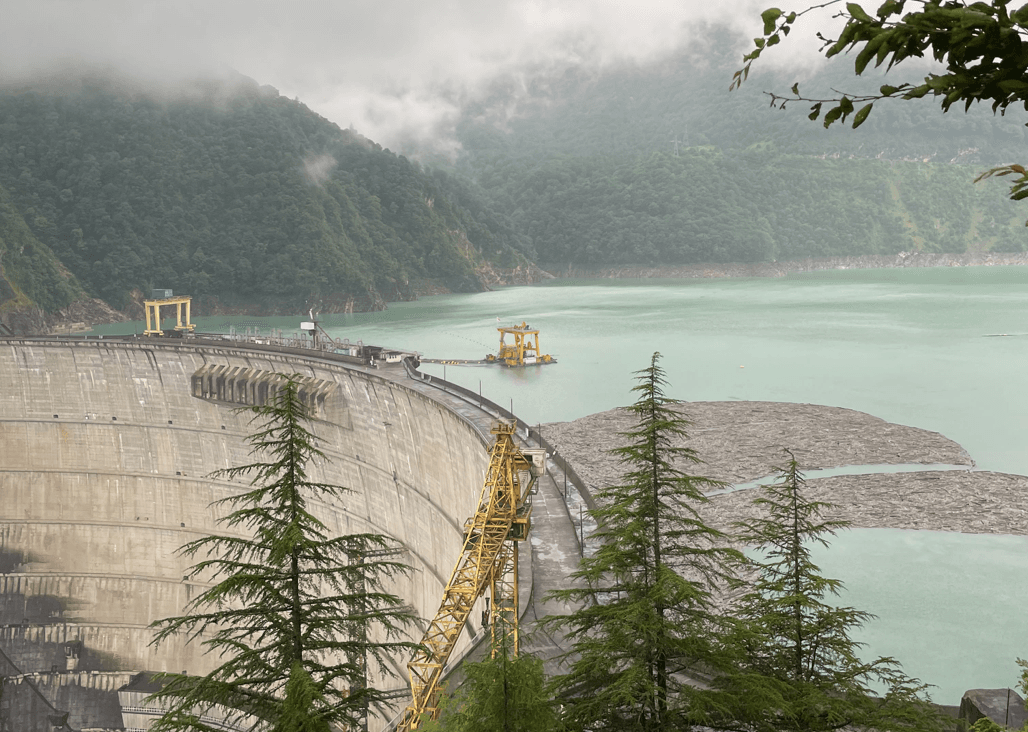 Enguri Dam. Photo: Liam Gibson
Georgia has suffered from three major blackouts this summer: July 23-24, July 25, and August 5. While few details have been released on the July series, the last blackout was attributed to technical failures and testing at Enguri Hydroelectric Power Plant (HPP), the country’s vital hydropower engine at the center of the entire grid. Georgia relies on hydropower as its primary energy source, which helps to ameliorate systemic issues with electricity access so much so that Tbilisi aims to become a regional electricity exporter. However, if blackouts continue to occur and its electricity imports continue to rise, then how feasibly can Georgia achieve this goal?
Blackouts, Caucasian Style
On the night of July 23-24, nearly all of Georgia and Russian-occupied Abkhazia lost electricity. The de-facto Abkhazian Ministry of Energy blamed a problem at Enguri HPP, but the Georgian side never named the official reason. One day after power was restored, on the morning of July 25, a second blackout occurred that again threw Georgia, including Abkhazia, into darkness. The blackout interruptions caused problems with water supplies, internet connections, and rail transport across the country. Adding a further twist to the situation, the State Security Service of Georgia that same day opened criminal proceedings under Article 318 which pertains to sabotage in the country’s criminal code.
The final blackout occurred less than two weeks later on the evening of August 5. According to Commissioner of the Georgian National Commission Energy and Water Supply Regulatory Commission Giorgi Pangani, testing at Enguri HPP meant to determine the cause of the prior two blackouts resulted in the third outage. The statement suggests that all three blackouts were at least partially caused by problems at Enguri HPP, raising serious questions regarding Georgia’s energy security.
Electric Shuffle
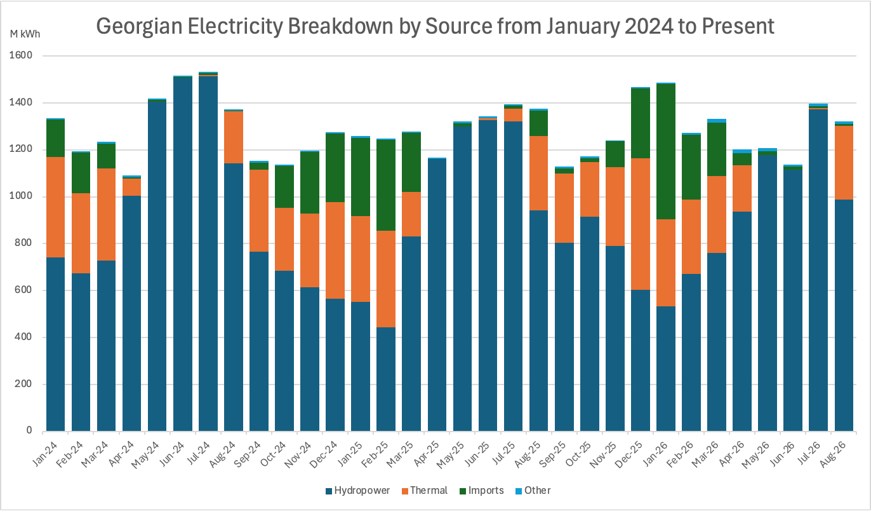 Data sourced from Georgia’s Electricity Market Operator (ESCO).
Georgia generated nearly 80 percent of its own electricity from hydropower in 2025, though reliance varies throughout the year. Since the country’s energy production is sourced from glacial melt, hydropower can meet nearly all of electricity demand in the warm summer months. During the winter, however, thermal power contributes to about a third of available electricity, accounting for imports. Thermal power plants are powered by natural gas, imported primarily from Azerbaijan via the South Caucasus Pipeline (SCP) and from Russia. Foreign electricity imports make up nearly 13% of total annual supplies, and their proportion of Georgia’s electricity supply increases during winter months. In 2025, around 62% of imports came from Russia, 27% came from Azerbaijan, 5% came from Armenia, and 3% from Türkiye. Most Russian imports of electricity go to Russian-occupied Abkhazia in the country’s northwest corner.
This summer’s blackouts are just one of several examples of Georgia suffering from blackouts during the months when hydropower dominates energy generation. Vulnerabilities for the Georgian energy system become most apparent during the times of heaviest dependence.
Dam Dependence and the N-1 Criterion
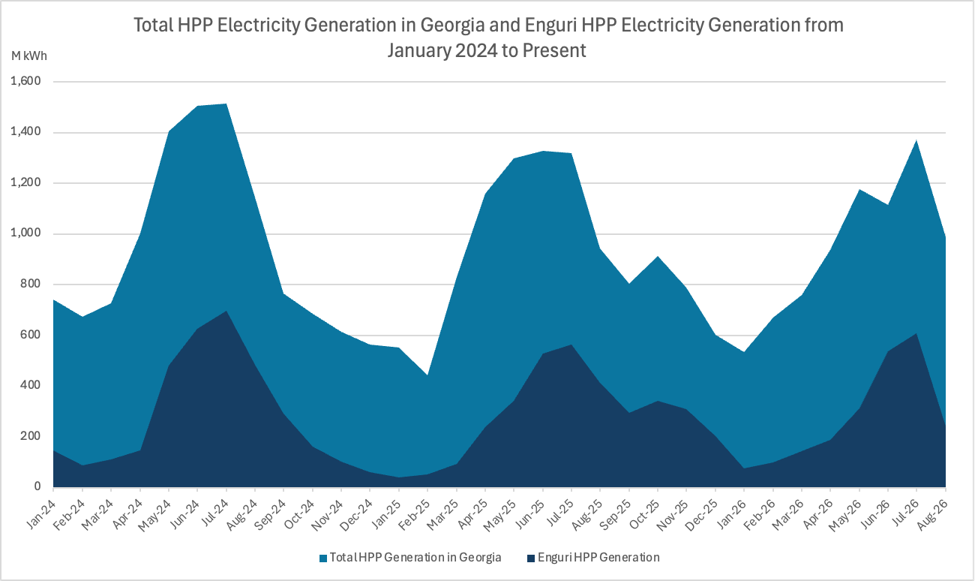
Data sourced from Georgia’s Electricity Market Operator (ESCO).
Enguri HPP supplies roughly 40 % of Georgia’s total electricity during the summer. Its generation dwarfs that of any other year-round HPP, supplied with a reservoir and supplemented by seasonal glacial flows for massive output. Enguri’s five generators, located in Abkhazia and connected to the dam via a system of underground pressure tunnels, have a maximum power capacity of 1,300 MW (megawatts) of electricity. Its downstream tailrace facilities can support another 340 MW. Enguri supplied 3428.8 M kWh (million kilowatt-hours), or roughly 31%, of Georgia’s electricity in 2025. Seasonal hydropower generation comes from 21 facilities, including 760 M kWh from Vartsikhe HPP and 478 M kWh from Dariali HPP in 2025. Meanwhile, “small” HPPs provide a tenth of annual hydroelectric power.
Compared to other countries in the Caspian region that similarly depend on hydropower, namely Tajikistan and Kyrgyzstan, Georgia’s hydropower is more consistent across seasons. However, like Nurek HPP in Tajikistan, Enguri is a product of institutional engineering shortcomings dating back to the Soviet Union. Both Enguri and Nurek were constructed to be in the middle of a larger cascade system. Lacking synchronization with cascade partners Khudoni HPP and Tajikistan’s Rogun Dam, respectively, Enguri and Nurek have become primary power sources in their energy generation systems.
Khudoni HPP would have added 20% more generation capacity to Georgia’s grid—former Georgia Prime Minister Nika Gilauri claimed when the project was reconsidered in 2011—improving its overall resilience. However, the fall of the Soviet Union, Khudoni’s cost to cash-strapped Tbilisi, and the project’s dismal public reception due to fears of serious environmental consequences meant that it was never completed.
However, the problem in Georgia encompasses more than generation capacity. Theresa Sabonis-Helf, a professor at Georgetown University’s School of Foreign Service and a Caspian Policy Center board member, elaborated, “[Enguri] had a lot of trouble with siltation because if you’ve built a reservoir that you didn’t expect to be the top of your cascade –and imagine that the river is full of silt, and it’s crashing for a very long distance –then all that silt is building up at a dam in a reservoir that was designed to be in the middle.”
As a result, Georgia’s grid falls short of the N-1 criterion, the standard used to measure an electrical grid’s resilience. It indicates whether a system can continue functioning if one critical component goes down. When generation at Enguri HPP is disrupted, the entire Georgian grid may follow.
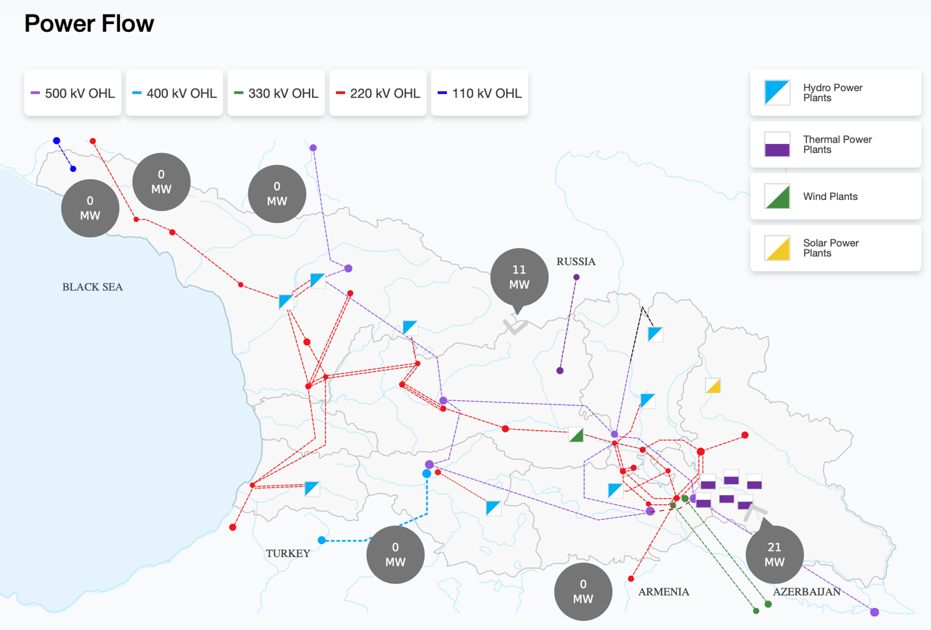
Map of power sources and transmission network in Georgia, including electricity imports and exports as of 6:41 am EST on Thursday October 1, 2026. Source: Georgia State Electrosystem (GSE).
Georgia has already solved a historic weak point in its energy architecture. The Soviet-era Trans-Caucasian Interconnected Power System ceased functioning after independence in 1991, leaving Georgia’s grid split in two. Its large HPPs in the west were optimized for export to Russia, and Tbilisi forfeited fuel suppliers for thermal plants in the east when the country could not make payments to Moscow. As a result, a single east-west transmission link connected electricity in the east of the country to populations in the west. Maintenance was underfunded, the grid suffered from systemic instability, and daily life in Georgia was plagued by frequent power outages—especially during the country’s civil war in 1991-1992 and afterwards.
By the 2010s, Georgia began to reform its energy industry wholesale. The government crucially began enforcing electricity payment collection from households and businesses, while U.S. and E.U. investments helped improve the grid. By 2019, the Organization for Economic Co-operation and Development assessed the grid to be of high quality and economic strength. Work to further improve and expand Georgia’s power grid began in 2020 with partial funding by the European Bank for Reconstruction and Development.
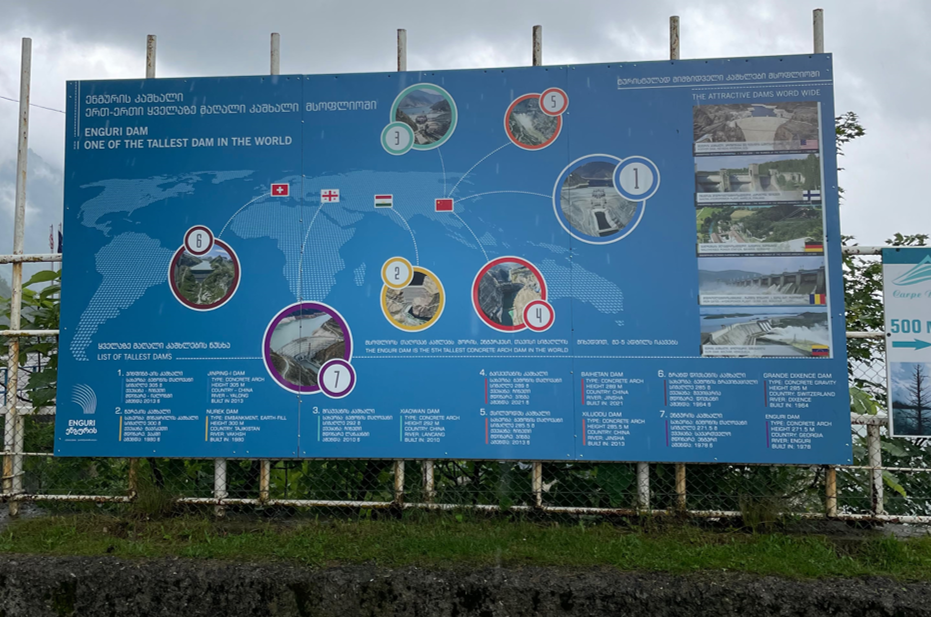
Informational Sign at Enguri Dam. Photo: Liam Gibson
Growing Demand and Export Dreams
A common source of Georgia’s unexpected electricity demand surges has been attributed to unregulated cryptocurrency mining. This process, which requires constant computer operations and regular cooling, can add strain onto existing grid infrastructure, especially if crypto-mining remains unregulated. Cryptocurrency miners frequently operate in Tbilisi, but the problem is widespread across the region. In Abkhazia, for instance, authorities apprehended illegal crypto-miners coming largely from Russia. Authorities also seized 148 cryptomining devices in Svaneti in June 2026. The region is home to numerous power outages that led to the crackdown, as Svaneti historically receives free electricity due to a legacy agreement with the local government.
Demand surges are apparent in everyday life. Hotter summers intensify air conditioning use in households, while industry and business absorb the rest. Georgia’s HPPs are generally located in the western parts of the country, while the largest population centers are in the east.
Despite concerns over domestic energy instability, the country has not given up on its pursuit of becoming a regional energy exporter. Since expanding its hydropower capacity, Georgia’s primary customer has been Türkiye. Both countries’ grids allow for electricity trade, as Georgia provided Türkiye with 401.4 M kWh in 2025. That said, Türkiye has improved its own hydropower generation in recent years, bolstering its self-reliance and reducing the need for Georgian energy purchases.
Regional Integration? Unclear
Plans for the Trump Route for International Peace and Prosperity (TRIPP) have raised broader questions regarding the South Caucasus’ regional cooperation and broader connectivity. In principle, the motivations and reason are there from all parties. Georgia still hopes to import natural gas and electricity from its neighbors, but it also seeks to increase its seasonal electricity exports. Armenia seeks stable sources of electricity as it looks for a replacement for its aging Metsamor nuclear power plant (NPP). Azerbaijan is a net energy and electricity exporter thanks to its domestic gas reserves, which also provide it with a business opportunity to help expand regional connectivity.
But feasibility is another question. The South Caucasus grid landscape is still too individualized and disconnected, requiring adequate investment and real consideration of technical questions to pursue further grid integration. Currently, Georgia’s grid is synchronized with Russia’s and Azerbaijan’s. Türkiye’s grid follows European grid network standards, but since it purchases most of Georgia’s electricity exports, a back-to-back high-voltage direct current (HVDC) converter was constructed in 2013 to facilitate asynchronous flows. An HVDC allows transmissions to continue across different frequencies and voltages.
Meanwhile, Armenia operates asynchronously from Georgia, and current electricity trade flows through 110 kV and 220 kV (kilovolt) cross-border transmission lines—at limited capacity. To synchronize the grids, the European Union (EU) launched the Caucasus Transmission Network Project in 2015. This project consists of a 500 kV line from Georgia’s Marneuli substation to an HVDC station in Ayrum, Armenia. Though delays in financing and planning have slowed the project, new financing agreements were signed in March 2026, including a €120 million loan provided by German company KfW and a €15 million grant from the EU Neighborhood Investment Platform.
Looking Ahead
Georgia has launched the construction of several transmission lines to improve west-east electricity flows. Through diversification with renewable energy and thermal power plant overhauls, Georgia’s transmission operator (GSE) aims to reduce Georgia’s hydropower share from roughly 75% to 67% by 2030.
The country will likely continue pursuing projects that strengthen regional connectivity, including the digitization of trade customs and efficient transport along the Middle Corridor. It also aims to facilitate the 1,000 MW Black Sea Submarine Cable, funneling renewable energy generation from the South Caucasus to Europe by connecting Georgia to Romania. Proper investment and political will in Tbilisi are essential to following through on these projects and ensuring the country’s grid is adequately prepared.
Progress so far has been slow on regional integration, but the benefits are apparent. Ultimately, the success of Georgia’s involvement in these initiatives, as well as its own energy security, depends on the strength and resilience of its grid system.