Oil! Tajikistan Between Iran and a Hard Place

Author: Julia Mohr
10/28/2026
 shutterstock
Not Feuling Around
In the months since Ukrainian drones have incapacitated Russian refineries, Central Asia has been forced to look elsewhere for fuel. Tajikistan, which relies heavily on Russian fuel imports, responded by tripling its imports of oil products from other Central Asian countries and reviving plans for internal exploration. But with the other countries facing fuel shortages of their own, imports have scarcely been able to fill the gap. And while Tajikistan also approached Belarus, expressed interest in Chinese petroleum, and supposedly received 10,000 tons of fuel from Iraq in mid-July, none of these efforts amounted to anything permanent. So when Iran’s Minister of Oil Mohsen Pakhnejad stated on August 15 that Iran was ready to increase its exports of oil and petroleum to Tajikistan, Dushanbe emphatically accepted, requesting 2.5 million metric tons of oil products –80% of that amount in the form of 2 million metric tons of crude oil –annually from Iran.
Persian Inversion
Current diplomatic relations between Tajikistan and Iran focus on the countries’ shared Persian ancestry and mutually intelligible languages. As the only non-Turkic Central Asian country, Tajikistan receives many soft power diplomacy initiatives from Iran, including visa exemptions and the proposed “Union of Persian-Speaking Countries and Regions”. Trade turnover hit $254 million in the first half of 2026, representing an almost 15% increase from 2025. That same year, Iran became Tajikistan’s fifth largest trading partner, behind China, Russia, Kazakhstan and Uzbekistan.
However, the relationship between Tajikistan and Iran –even in light of Tajikistan’s recent request –cannot be regarded as substantial. Despite Iran’s status as Tajikistan’s fifth largest trading partner, their turnover is a pittance compared with that of Tajikistan and China or Russia. And while it was reported that an Iranian-built drone factory opened in Tajikistan in 2022 –perhaps signaling a closer defense relationship between the two countries –there remains no sign of the factory.
Tajikistan’s turn towards Iran isn’t news in itself: Iran and Tajikistan have discussed increasing energy integration before, and Iran has exported oil products to Tajikistan since well before the US-Iran war began. While Iran has only ever exported small amounts of refined oil to Tajikistan –505 tons in 2022, for example –the Western Asian country is an oil producing powerhouse, able to easily accommodate Dushanbe’s request that Iran increase its exports by a factor of 1,000.
Tajikistan’s Request: A Drop in the Barrel
In 2025, Iran exported, in aggregate, around 1.5 million barrels of crude oil a day, or approximately 78.4 million metric tons. By 2026, Reuters estimated that Iran’s internal production capacity of refined oil amounts to 2.6 million barrels per day, or around 355,000 tons. And Iran’s total reserves are estimated at 208.6 billion barrels, which would last the country 141 years. Tajikistan’s request, for Iran, is a drop in the bucket: slightly over Iran’s production of oil for one day. Importantly, Dushanbe has signaled that it sees Iran as a long-term partner in the energy trade. As part of the August 15 discussion, Dushanbe proposed a “green corridor” from Iran to Tajikistan, along which the fuel would travel by 51,000 railway cars. Such infrastructure would promote Iran, rather than Russia, as Tajikistan’s forefront energy exporter.
Refined Taste
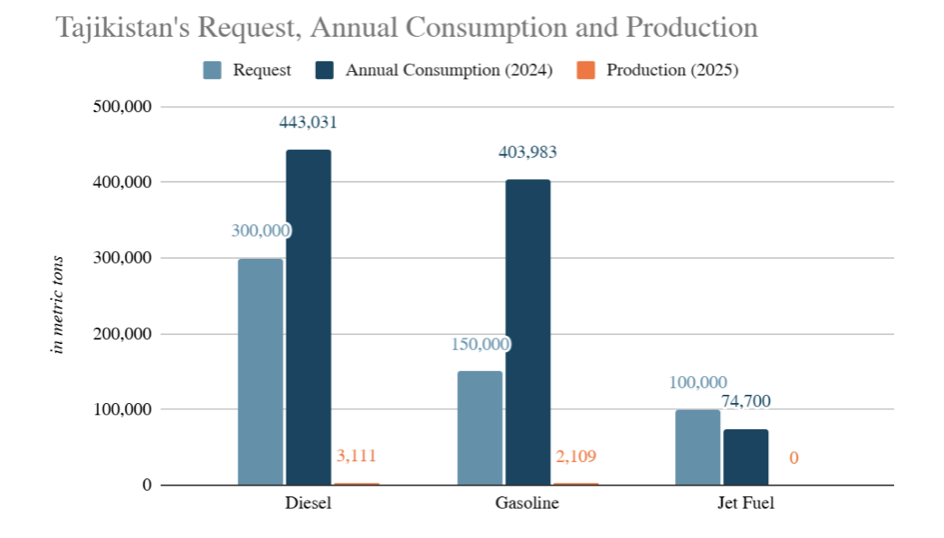
The 0.5 million metric tons of refined petroleum requested by Tajikistan break down into 300,000 tons of diesel, 150,000 tons of gasoline and 100,000 tons of jet fuel. Tajikistan’s demands for these refined products have increased dramatically over the last 25 years, as already insignificant domestic production of diesel declines and gasoline amounts to 0.5% of Tajikistan’s annual consumption. While Iranian imports won’t cover the full gap left by Russia’s absence –92% of petroleum imports to Tajikistan –they’ll greatly lessen the blow, given extremely insufficient domestic production.
 A Crude Awakening
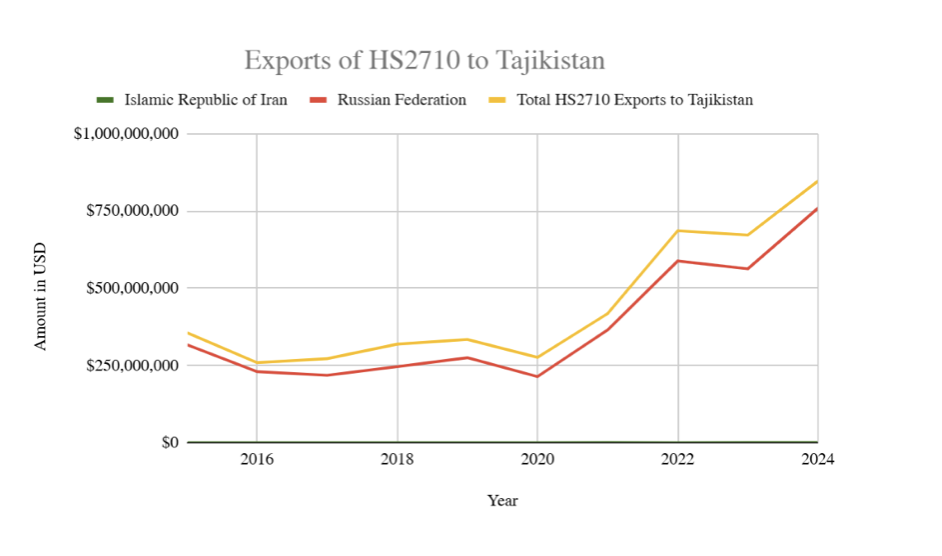
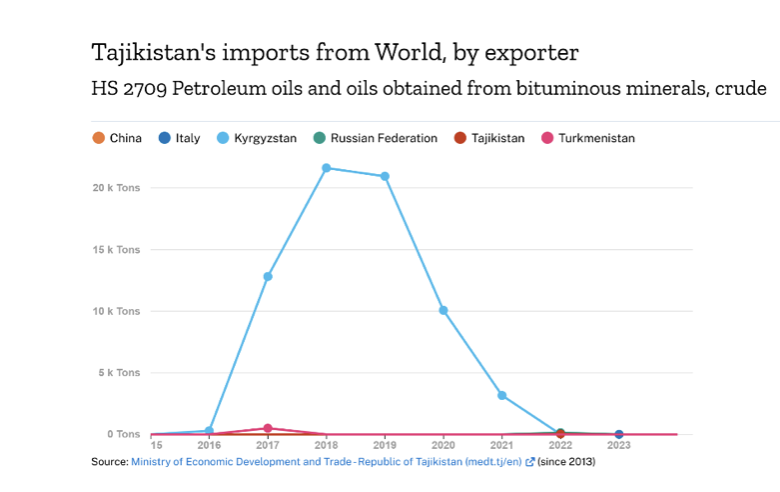
Tajikistan’s Iranian petroleum import is distinguished from past Russian imports in quantity as well as kind. Iran has never been a major fuel supplier to Tajikistan, as exports from Russia historically dwarfed all other contributions to Tajikistan’s energy sector. Furthermore, Tajikistan’s request for crude petroleum products represents a total reversal of Tajikistan’s historic modus operandi regarding fuel acquisition.
 Source: Trademap.org
As shown in the chart, refined oil from Russia dominates Tajikistan's refined fuel imports: Iranian refined oil imports barely surface. Similarly, crude oil imports have generally comprised a fraction of refined oil imports. Over the last 10 years, only Kyrgyzstan, controversially, has exported meaningful amounts of crude oil –slightly over 20,000 tons in 2018 and 2019, during its peak –to Tajikistan. Excluding imports from Kyrgyzstan, Tajikistan imports, on average, a total of between 100 and 500 tons of crude oil per year, from either Afghanistan, Turkmenistan or Russia. For comparison, Tajikistan imported around 700,000 tons of refined oil (HS 2710) in 2022.
Source: Trademap.org
Right Into the Dangara Zone
Once Iranian petroleum –mostly crude –arrives in Tajikistan, the question of refinement arises. Tajikistan’s largest and most modern refinery, Dangara, is a natural choice. Dangara is located to the southeast of Dushanbe and able to refine 1.2 metric tons annually – when operating at full capacity. But Dangara’s true capacity is unknown, as it frequently faces periods of disuse due to lack of product and even consumers, given the high prices of domestically refined petroleum.
The Dangara oil refinery itself was financed by a loan of $40 million from the Chinese Development Bank and built by a Chinese-Tajik subsidiary of Dong Ying Heli Investment and Development, which itself is associated with the Chinese National Petroleum Company. Although the refinery was completed in 2018, it was not operational until 2025 due to the price of petroleum. According to Asia-Plus, Chinese investors had discussed financing a second refinery in Tajikistan, although the project was later panned, most likely due to the lack of a domestic consumer market.
Tajikistan’s requested export from Iran –2 million tons of crude oil –greatly exceeds that amount. After all, there are other refineries in Tajikistan, although they lack Dangara’s capacity and modern capabilities. Tajikistan’s internal oil production seems to decrease by the year: while in 2022, it produced 25,000 tons, a year later, the number sank to 18,000. By 2024, Tajikistan was only producing 16,100 tons of oil, but Dangara itself only produced 800 tons of gasoline from around 1600 tons of semi-refined crude oil.
The Refiner Things in Life
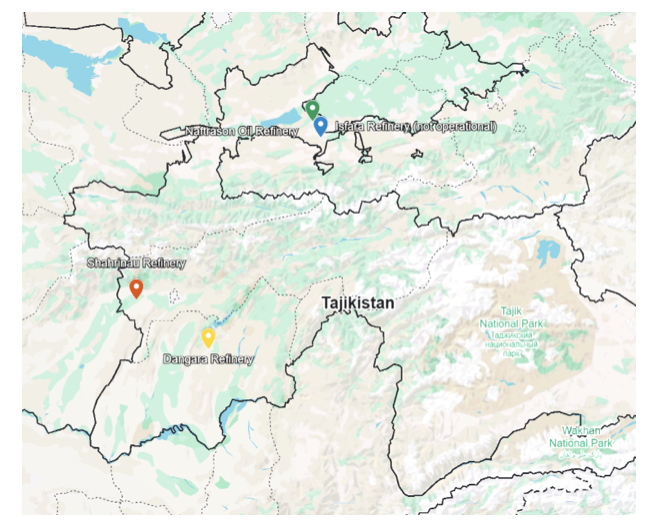
Evidence of the capacity of any of Tajikistan’s refineries is tenuous at best. While Dangara’s 1.2 million ton capacity was touted in local media, the refinery has only ever handled around 1500 metric tons – once in 2020, and more recently in 2024. Reports from the U.S. Geological Survey call into question the claimed capacities of the other two operational refineries. The reports estimate Shahrinau’s capacity at around 63,000 metric tons, rather than the publicized 100,000. Naftrason, which opened in 2016, operates at slightly below its planned production capacity, producing 68,000, rather than 70,000, metric tons. All in all, the numbers reflect that Tajikistan’s three running oil refineries operate at –optimistically –a collective 10% of their total capacity.
|
Name of Refinery |
Location |
Full capacity |
Current capacity |
In Barrels |
Year established |
|
🟡Dangara Oil Refinery |
Dangara Free Economic Zone, Khatlon Region |
11,840 barrels |
|||
|
🟢Naftrason Oil Refinery |
Kanibadam, Sughd Region |
68,000 tons4
|
20165 |
||
|
🔴Shahrinau |
Tursunzoda, Shahrinav District |
63,000 tons4
|
|
||
|
🔵Isfara (ОАО Sultonstoun) |
Isfara, Sughd Region |
In disrepair |
In disrepair |
||
|
TOTAL CAPACITY |
|
1,370,000 tons |
132,622 tons |
971,840 barrels (est) |
|
1 from a 2016 report
2 from a 2013 article
3 2024
4 USGS report 2020-1, based on estimation
5 expected by USGS to be operational by 2014, and “refined petroleum was expected to be exported to Kazakhstan and Russia”
Oil and Trouble
If Tajikistan has an estimated annual capacity to refine 132,622 tons of crude oil –disregarding how little information exists on the current capacity of Naftrason and Shahrinau –then the agreement to purchase 2 million tons of Iranian crude annually makes little sense. Even if Dangara's production capacity –the capacity of which was reportedly stymied by a lack of crude material –can be effectively mobilized, it’s unlikely that Tajikistan’s production capacity will be able to match its yearly 1.6 million metric ton demand for petroleum products.
Tajikistan produces 316 barrels –around 43 metric tons –a day, and consumes approximately 33,000 barrels –around 4,500 metric tons –a day: in other words, daily production can supply less than 1% of daily consumption. Annual production amounts to 15,695 metric tons. With these numbers in mind, it’s likely that the total capacity of Tajikistan’s three remaining oil refineries reflected above –132,622 tons –is a gross overestimate. That Tajikistan produced only 18,546 metric tons –135,000 barrels –of crude oil in 2025 provides evidence to this conclusion.
Between Iran and a Hard Place
Tajikistan’s emphasis on crude imports makes strategic sense: in theory. Still smarting from the sudden loss of refined Russian imports, Tajikistan has realized the drawbacks of energy dependence the hard way. And while Tajikistan cannot produce enough crude oil on its own to satisfy its domestic market, it can onshore production, thus securing an essential step within its own borders.
The secondary complicating factor to Tajikistan’s (forced) decision to pivot to Iranian exports of oil and petroleum is the current war between the United States and Iran. The United States’ Operation Economic Outcast not only seeks to isolate the Iranian economy, but promises punitive measures to other actors that continue engaging with Iran.
Tajikistan, unfortunately, has little other option. With the rest of the Central Asian nations scrambling to secure their own resources, and with China, Belarus and Iraq expressing little interest in establishing trade of petroleum products, Iran remains a logical partner for Tajikistan. Of those nations, Iran is also the best positioned to supply Tajikistan with crude, rather than refined, petroleum products. And although Tajikistan and the United States recently held bilateral talks regarding energy and water resources, no concrete future plans have resulted. For a small, landlocked country caught up in larger, surrounding wars, importing Iranian oil is worth the risk of American sanctions. Whether Tajikistan’s choice to import mostly crude oil will pay off in the form of energy independence remains to be seen.