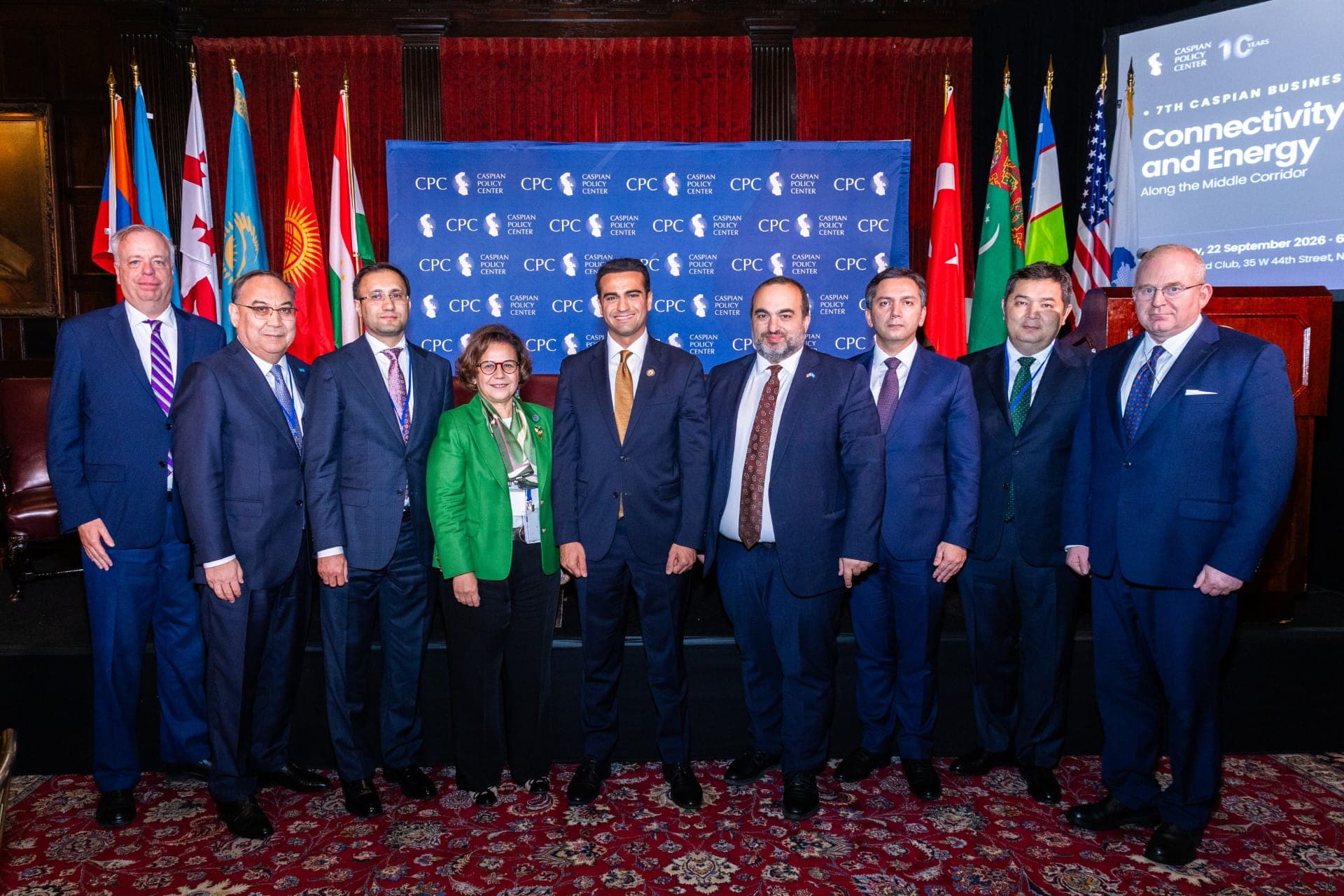
Wired Across the Caspian: The Trans-Caspian Fiber-Optic Cable and the Future of Digital Connectivity
Recent Articles


Author: Caspian Policy Center
11/11/2026 · 6 min read

Washington, DC, November 6, 2026 – The Caspian Policy Center (CPC) held a panel discussion on the Trans-Caspian Fiber-Optic Cable, bringing together industry experts, U.S. government officials, and the Kazakh and Azerbaijani ambassadors to the U.S. Once the first cable ever laid across the Caspian Sea comes online, it promises to provide a high-capacity data route linking Central Asia to Europe. The conversation explored the geopolitical balancing behind the cable’s construction, its impact on global connectivity, and the cable’s implications for digital sovereignty in the region.
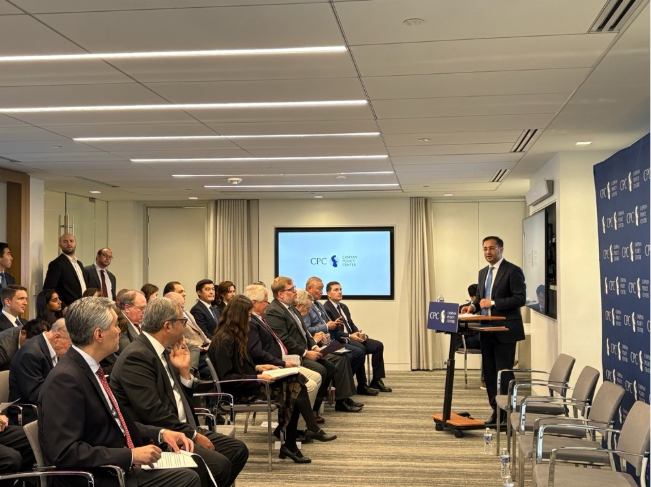
Efgan Nifti, Chief Executive Officer at CPC, delivered opening remarks highlighting the importance of the new cable to digital connectivity. He noted that the 380-kilometer fiber-optic cable is the first of its kind in the Caspian Sea and significantly diversifies the region’s digital infrastructure. Like roads, railways, and pipelines, the cable enables ambitious digital and AI strategies that open the door to exporting data and advanced computing capacity. This presents a particular opportunity for American companies. He elaborated, “American companies are already playing an important role in the region’s emerging digital economy… As digital infrastructure expands, there is considerable potential to deepen these partnerships.” Nifti also emphasized the project’s significance for future Caspian developments in other sectors, stating, “This is a proof of concept for building connectivity under the Caspian Sea.”
Ambassadorial insights were provided following Nifti’s opening remarks. Azerbaijan’s Ambassador to the U.S. Khazar Ibrahim noted that the fiber-optic cable’s completion is a microcosm of a broader record of Azerbaijan-Central Asia connectivity. He pointed out that “culturally, linguistically, historically, ethnically, the countries of Central Asia and Azerbaijan have been wired. We have been getting even stronger through economic cooperation.”
Ibrahim added, “We are not ending with this cable, but I think it’s the most important part of a much larger picture.” He pointed to the existing 1,200-km cable under the Black Sea between Georgia and Bulgaria as part of that broader picture. Ibrahim also mentioned that Azerbaijan has proposed an initiative to connect with Turkmenistan as well.
Kazakhstan’s Ambassador to the U.S. Magzhan Ilyassov provided the perspective from the other side of the sea, stating: “Reliable, high-capacity data links are now as essential to regional integration as supply chain resilience and physical transport corridors.” He emphasized that Kazakhstan is also developing these other aspects of connectivity, recalling a new government initiative of more than US$14 billion through 2029 to modernize transport, logistics, engineering, and social infrastructure in the country. The cable will play a large role in Kazakhstan’s goal to become an economic, transport, and digital technologies hub. As the ambassador explained, “Our objective as a nation is to develop one of the leading computing ecosystems in Central Asia, and to position the country as a practical digital bridge between Europe and Asia.”
Ana Nakashidze, Chief Executive Officer, AzerTelecom International and CaspiLink, explained how AzerTelecom and Kazakhtelecom collaborated to open a new digital corridor despite geopolitical realities and technical constraints. Nakashidze noted that while the internet is often thought of as virtual and borderless, it runs on “physical infrastructure defined by technology, geopolitics, and economics.” She then described some of the obstacles faced during construction, such as the lack of a maritime route to deliver the cable to the Caspian Sea. Instead, the cable traveled overland on three trucks, each carrying more than 200 tons, an effort in which Kazakhtelecom played a central role.
Nakashidze added that the Trans-Caspian Fiber-Optic Cable has been proposed multiple times over the past 20 years, but skepticism had remained strong. No cable had ever been laid on the Caspian seabed, leaving a lack of precedent and proof of concept. Nevertheless, Nakashidze said her team treated this as an advantage: the opportunity to define the process, set a precedent, and work directly with state entities.
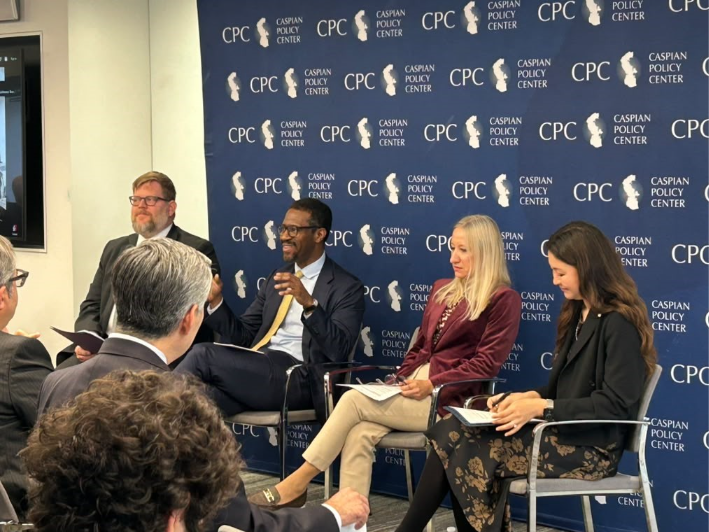
Ean Hundley, Director, ICT and Infrastructure Policy, Office of Foreign Policy, U.S. International Development Finance Corporation, offered his views on the cable’s significance to the U.S. and DFC’s role in advancing trusted infrastructure in the region. He noted the importance of digital route diversification and pointed to the synergies between digital connectivity and the Trans-Caspian International Transport Route. This opens the door for greater U.S. and particularly DFC involvement in the region.
Hundley noted that digital infrastructure, including supporting the American SI Exports Program, is a key focus for DFC, which seeks to assist U.S. and allied companies with strategic investments. He described DFC as the investment arm of the U.S. Government, which weighs each project on its alignment with U.S. foreign policy and national security interests, the commercial viability and on its economic benefit to the United States and its partner countries. In the Trans-Caspian region, that means investing in transportation, energy, minerals, and digital infrastructure simultaneously.
Justin Fair, Director for Bilateral and Multilateral Affairs, Bureau of Cyberspace and Digital Policy, United States Department of State, described the cable as an important source of route diversity, giving the region new pathways to European, American, and other global markets. He noted that connectivity is central to the region’s digital ambitions, and that the U.S. government wants to be a partner in turning it into economic opportunity. Furthermore, Fair emphasized that trust is built through decisions made throughout a project’s lifecycle, including how infrastructure is repaired, maintained, and operated.
Romina Bandura, Senior Fellow, Project on Prosperity and Development, CSIS, provided the global context for the Caspian project. She explained how subsea fiber-optic cables are critical infrastructure that enable the internet and global communications. In the case of the Caspian project, Bandura highlighted the importance of redundancy and diversifying from usual routes, reinforcing that this particular fiber-optic cable is more than just an economic project. She emphasized that the Caspian cable would strengthen countries’ national security providing alternatives to “previous routes through Russia that had surveillance risks because the Russian security services could access them.”
Additionally, the cables require maintenance and repair in the event of accidental or intentional cuts. Bandura mentioned that they can also be damaged by natural disasters, such as volcanic eruptions and earthquakes. She reaffirmed the importance of cables in carrying international data traffic, noting that satellites can be a complementary technology but cannot fully replace them, given their higher costs, latency, and communications capacity limitations.
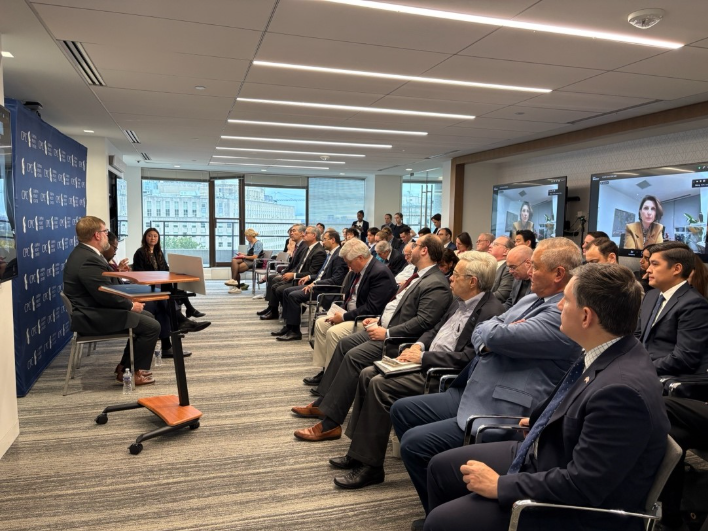
Finally, Dr. Akbota Karibayeva Meyer, Program Director for Tech Policy at CPC, who moderated the panel, offered closing remarks: “If there is one thread running through today’s discussion, it is this: the cable is a milestone, and also a starting point. What comes next depends on the partnerships built around it, among the countries of the region, with industry, and with the United States.”
The Trans-Caspian Fiber-Optic Cable furthers ambitious AI and digital infrastructure agendas in a critical region for global connectivity. The cable provides a valuable new foundation for digital sovereignty that may prove to be key in developing the project into an enduring commercial asset. While several questions remain, particularly regarding maintenance, the cable is a significant milestone in the Trans-Caspian region’s push to become integrated into markets and supply chains with a global footprint.