Kazakhstan Should Rethink How It Accepts Repatriated Ethnic Kazakhs
Recent Articles


Author: Dante Schulz
06/15/2021 · 4 min read

On May 23, Kazakhstan’s Deputy Interior Minister Arystangali Zapparov informed three ethnic Kazakhs who crossed the Chinese-Kazakhstani border in recent years that Kazakhstan would be unable to grant them Kazakhstani citizenship. Qaisha Aqan, Murager Alimuly, and Kaster Musakhanuly are ethnic Kazakhs who were granted temporary refugee status in the Central Asian country in October 2020 after alleging that they were forced to flee China to avoid internment in political re-education camps in Xinjiang. Human rights groups have accused China of detaining Uyghur Muslims and other minorities in Xinjiang, including ethnic Kazakhs, in re-educational camps. China has denied the claims, instead saying that they are vocational training schools.
The Kazakhstani government has previously implemented a system to return ethnic Kazakhs who were displaced or moved during the Soviet Union era. Shortly after the Soviet Union dissolved, Kazakhstani leaders adopted an approach to encourage ethnic Kazakhs to return, earning repatriates the label “Qandas” or “blood relative.” They were previously referred to as “Oralman” meaning “returnee,” but the term was dropped in all legal Kazakhstani texts following a law passed in May 2020. The term oralman has taken on a negative connotation, and those so labeled often say that they are never able to shed the distinction.
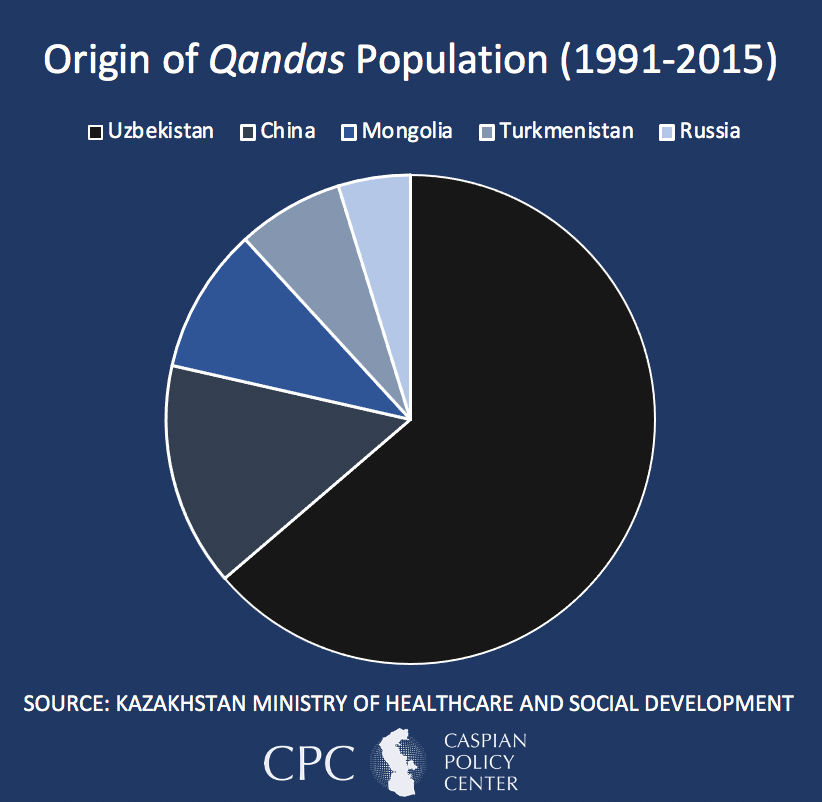
About one million ethnic Kazakhs, primarily from Uzbekistan and China, resettled in Kazakhstan between 1991 and 2015 under this policy. They comprise approximately 5.5 percent of the country’s population.
In October 2019, Alimuly and Musakhanuly arrived in Kazakhstan and offered video testimonies detailing their accounts of ethnic Kazakhs and other minorities living in China’s western Xinjiang Uyghur Autonomous Region. In 2016, the Chinese State Committee for Nationalities revealed that 1.46 million ethnic Kazakhs lived in China, of which 1.42 million resided in Xinjiang. In 2018, Aqan crossed the border from China after claiming that her deportation would result in the Chinese government placing her in a re-education camp. A Kazakhstani court ruled that the three ethnic Kazakhs would not be deported to China, but their status in Kazakhstan remained unknown.
Nur-Sultan claims that the decision to reject the three refugees’ status for Kazakhstani citizenship was made because they were detained crossing the border illegally before they gained residency status in the country and, thus, had not followed proper procedures. However, the political decision not to offer citizenship to ethnic Kazakhs crossing the border from China signals Kazakhstan’s hesitancy to jeopardize its relationship with Beijing and suggests that Kazakhstan is focusing on preserving its bilateral relationship with its eastern neighbor.
The decision to deny the three refugees’ requests for citizenship came as more than 250 ethnic Kazakhs were repatriatedto Kazakhstan from Turkmenistan for resettlement. Ethnic Kazakhs residing in Turkmenistan were able to immigrate under the officially outlined policy, but those from China were forced through additional hurdles, raising questions for ethnic Kazakhs originating in China who seek asylum in the Central Asian state. In addition, qandas who live and work in Kazakhstan for five years are granted the full right to claim Kazakhstani citizenship. Kazakhstan might have wanted to avoid a situation in which they anger China by granting these three refugees Kazakhstani citizenship. However, Nur-Sultan’s decision to do so raises eyebrows on its qandas policy.
While Kazakhstan presents itself as welcoming to qandas, many ethnic Kazakhs who have returned to their ancestral homeland report experiencing isolation and stigma. There is a lack of government support for the qandaspopulation, and many depend on relatives already settled in Kazakhstan to support them financially and socially. In addition, those that are outside of the government-designated quota system find it difficult to register and integrate into Kazakhstani society. Qandas also often struggle to register with the state, impeding their ability to access social services and leaving them vulnerable to abuse and discrimination. For instance, qandas were accused of fueling a protracted oil-worker strike in 2011, although many non-repatriated Kazakhs also participated in the protests. Nevertheless, the government responded by limiting quotas to repatriate ethnic Kazakhs, stymying the flow of Kazakhs resettling in the country. Though Kazakhstan’s relationship with China has brought the qandas policy into focus, the program has a broad set of problems that the government should look to resolve.
Kazakhstan’s relationship with its returnee population is complex. On the one hand, it wants to serve as a country that embraces its diaspora population and supports the repatriation of roughly four million ethnic Kazakhs living abroad. However, Nur-Sultan’s stance is complicated by both domestic and international pressures when accepting qandas. The non-repatriated Kazakhstani population has grown uneasy over the steady stream of qandas, which can place Nur-Sultan in a difficult situation if left unaddressed. Furthermore, the specter of Beijing will inevitably loom large in Kazakhstan’s qandas calculus. The decision to reject the citizenship requests of Alimuly, Musakhanuly, and Aqan underscores Kazakhstan’s commitment to its relationship with China and foreshadows a turning point for its repatriation policy. If Kazakhstan wants to maintain its positive relationship with Beijing while also acting as a home for the global Kazakh population, it should find creative ways to engage Chinese policymakers behind the scenes.
Photo Source: Ruslan Pryanikov/AFP/Getty Images