COVID-19 and the Greater Caspian Region
Recent Articles


Author: Caspian Policy Center
04/03/2020 · 5 min read

“COVID-19 is the greatest test we have faced together since the formation of the United Nations,” UN Secretary General Antonio Guterres said April 1, stating what many have felt — and feared — is indeed the case. As an American, if someone had told me a month ago that New York City would be shut down because of the disease, I would have said they were crazy. Now New York has been shut down for weeks and such restrictions on movement, social engagements, and business are overwhelmingly accepted as necessary by Americans, as confirmed in a report that the Brookings Institution released March 30.
The nine countries of the Greater Caspian Region also face severe challenges from the global spread of the coronavirus. These challenges are longer term as well as immediate. They affect individuals as well as institutions. They are domestic as well as international. And actions that individuals, governments, businesses, academic institutions, and other entities take now may also shape dynamics within these nine countries and the region even after COVID-19 is brought under control.
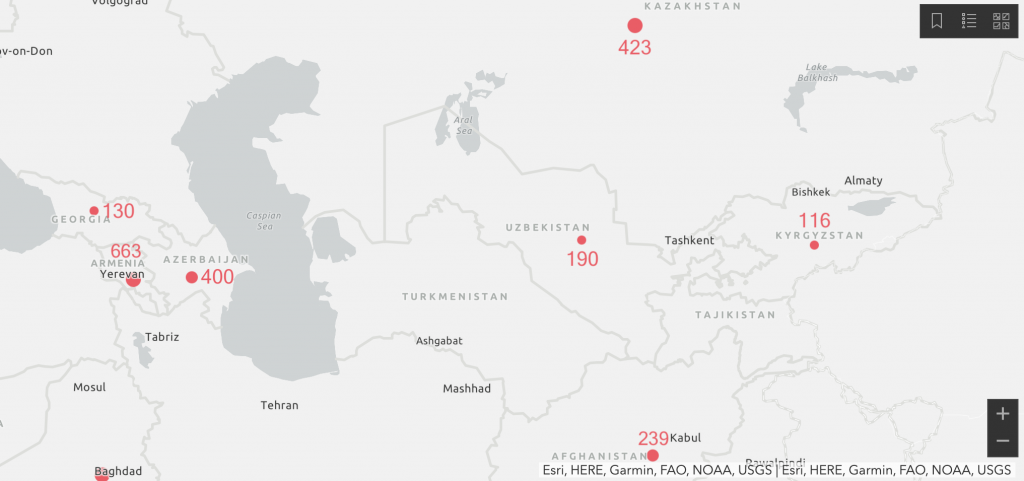
Map of confirmed cases of COVID-19 in the Caspian Region. Source: Coronavirus Resource Center, John Hopkins University.
First and foremost are the actions to help those in these countries who are ill with the virus and to help protect the people of the region against its further spread. Health systems, whose reach and other capabilities often vary within the countries of the region, as well as among these countries, are generally under strain. Those strains, whether in terms of doctors, nurses, and other essential healthcare workers, facilities, or equipment, may grow tougher, as they have in other parts of the world. Stay-at-home orders, which experts see as essential to managing the spread of the virus and saving lives, will also mean social as well as personal stress, including within families whose living space may already feel constrained and may come to feel more so as parents stay home from work and children are home from school.
Economically, closed enterprises or even just constricted business activities will mean lost sales, services, customers, and incomes. Domestic as well as regional and international transportation networks and supply chains are disrupted and look likely to remain so for an indeterminate period. Corporate debt looks likely to increase. Higher unemployment will tax the varying capacities of the social safety nets in the countries of the region. As elsewhere in the world, business owners and company workers will wonder whether their firms will survive and reopen.
Actions by Russia and other countries to close their borders are likely necessary but will also mean migrant laborers cannot return to their jobs, and thus mean a fall in remittance incomes as well as a rise in unemployment in the region. Tajikistan, for example, where remittances make up a very large portion of its GDP, already reports migrant workers from its country are unable to return to their jobs abroad.
Other global economic developments also affect the region. The concurrent disruption in world energy markets will be particularly important for oil exporting states such as Azerbaijan and Kazakhstan, and for gas exporter Turkmenistan. Coming at a time when oil supplies were already outpacing demand, the fight between Russia and Saudi Arabia is further flooding markets. Adding to the downward pressure on oil prices is the expectation of further slowdowns in the global economy due to the COVID-19 crisis, the lack of storage world-wide for the additional amounts of oil that are being pumped, and the lack of progress in discussions among the leaders of oil-producing states. While national sovereign wealth funds, such as SOFAZ in Azerbaijan and other such mechanisms in other countries can be utilized, the situation in oil markets will mean lower foreign exchange earnings and greater fiscal pressures on the governments of the region’s hydrocarbon exporters. At the same time, however, lower oil prices can benefit industrial as well as private consumers.
As elsewhere, more is demanded of telecommunications and the Internet as well as of other critical infrastructure systems by the governments, businesses, and societies in the Greater Caspian Region. At the same time, these and other critical infrastructure systems are open to threats. In addition to the systems’ age and capacity constraints, there are questions about how prepared these information technology networks are to face new cyberattacks, whether from amateur hackers, terrorists, or state-sponsored actors. Moreover, there is little reason to think the countries of the Caucasus or Central Asia will be safeguarded against malicious or other disinformation about COVID-19 being distributed over the worldwide web or from the Internet being used to defraud and endanger individuals with claims of false cures.
While domestic actions are essential, so is coordinated action among the governments in the region and beyond. The record already shows that the timely sharing of fact-based information among the governments, as well as with domestic populations, is invaluable in combating the virus. So is the provision of necessary funds and equipment. USAID and the U.S. State Department have made available nearly $274 million to fight COVID-19 internationally. Other governments also are providing aid as are the International Monetary Fund, the World Bank, the Asian Development Bank, the European Bank for Reconstruction and Development, and other such international financial institutions. China is moving to help states by sending them respirator masks, COVID-19 test equipment, and medical staff. However, such aid has raised concerns in Washington and elsewhere as to the extent it could be used, like some projects constructed in the Belt and Road Initiative (BRI), to expand Beijing’s influence in the region. Yet analysts also note that unlike in past crises, the United States is not taking a leading role in organizing, coordinating, and executing an international response. As with other issues inherent in fighting COVID-19, actions taken now can have long-lasting ramifications.
Authors
Ambassador (Ret.) Robert Cekuta, CPC Board Members
Efgan Nifti, Executive Director, Caspian Policy Center
Ambassador (Ret.) Richard Hoagland, CPC Board Members
Ambassador (Ret.) Allan Mustard, CPC Board Members