Yerevan’s Nuclear Question Might No Longer Have an American Answer


Author: Kurtis Yan
10/06/2026
 primeminister.am
Armenia’s nuclear energy diplomacy sits in the spotlight of renewed U.S. attention to the South Caucasus. After all, the United States was one of five potential partners to help construct a new nuclear power plant (NPP) to replace its aging Metsamor NPP, maintained by Russian state nuclear company Rosatom.
While much energy and momentum were growing towards the potential of small modular reactor (SMR) cooperation between Yerevan and Washington, Prime Minister Nikol Pashinyan is now revealing the country’s wariness to choosing an alternative nuclear vendor. And in the coming months, this might reaffirm Russia’s involvement in its nuclear industry in the long run.
Why Pashinyan’s Statement Could be Troubling
Pashinyan stated that Armenia’s energy outlook has changed since the country initially began its search for a nuclear energy partner. He cited the construction of new data centers for artificial intelligence (AI) and other large investment projects that have transformed the country’s energy surplus into an energy deficit. Despite initial support, he later noted that SMR technology might no longer sufficiently meet the country’s growing energy needs, as opposed to a traditional 1-gigawatt (GW) NPP. He later went on to say that he would reach a decision in the “coming months.”
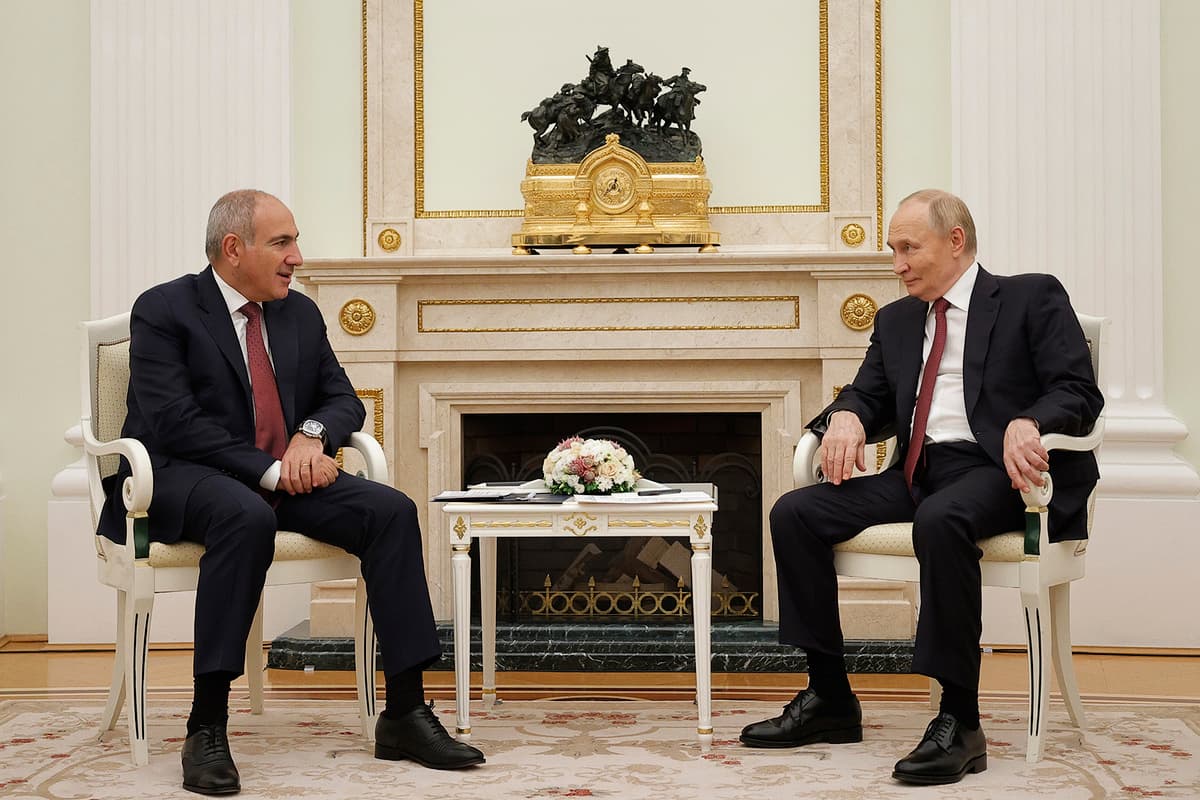
Pashinyan’s latest statement comes just two days after meeting with Rosatom Director General Alexei Likhachev in Yerevan. The two discussed maintenance to extend the lifespan of Metsamor to 2036. They also spoke about Rosatom’s proposal to construct a 1-GW NPP, as well as smaller-capacity units. Pashinyan has insisted that Armenia would make its choice based on economic pragmatism, independent of geopolitics.
The Context
Metsamor generates around 30 percent of Armenia’s total electricity. Since 1995, Armenia has added several safety upgrades to Metsamor to address seismic risks, with assistance and review from the International Atomic Energy Agency (IAEA) to operate. Nevertheless, the power plant’s old age presented an unavoidable issue. Rosatom repaired the plant and extended its lifespan, though more maintenance is needed to operate until 2036. At that point, Metsamor would be decommissioned, barring a further upgrade.
To solve this issue, Yerevan had gathered a circle of potential partners last year: China, France, Russia, South Korea, and the United States. Pashinyan insisted on his preference for SMR construction in the country, providing a safer, more flexible, and more environmentally friendly alternative to a normal-scale power plant. SMRs, however, have not been successfully implemented for commercial production to justify upfront costs, creating a race to develop scalable technology.
The United States, with persistent interest in developing SMR technology, attempted to take the lead on this venture. After all, Washington and Yerevan had signed a memorandum of understanding (MoU) on strategic nuclear cooperation back in 2022, while a 2025 MoU explicitly calls for civil nuclear technical cooperation on SMRs.
Since then, Washington and Yerevan have maintained strong mutual interest in nuclear cooperation. During his visit to Yerevan in February of this year, U.S. Vice President J.D. Vance announced the conclusion of negotiations on a 123 Agreement with Armenia to export nuclear materials and technology. Vance also recognized that civil nuclear cooperation could generate up to $9B in U.S. material exports, fuel, and long-term maintenance to Armenia for a new nuclear reactor.
As such, the foundation was laid, and the United States was the arguable frontrunner in the race. Momentum rose between Armenia and the U.S. to cooperate, but Pashinyan’s latest doubts over SMRs indicate that the landscape—and the race—have changed.
Forces Colliding: Energy Insecurity, Time Horizons, and Threats
Armenia’s new energy-intensive projects could justify Pashinyan’s change in tone. The country’s energy demand has grown to the point that electricity imports from Azerbaijan and Türkiye could be on the table.
That said, another reason could be Washington’s lack of provable SMR technology to show for its interest. Previous SMR projects in the United states failed to produce tangible results. For instance, NuScale planned to construct an SMR in Idaho but failed, due to insufficient capital and electricity demand, ultimately shutting the project down.
In September, the Tennessee Valley Authority received the first federal permit for a public U.S. utility to construct a BWRX-300 SMR for commercial use. While promising, any potential progress now might not meet Metsamor’s 2036 time horizon. Given the concreteness of Rosatom’s nuclear proposal, it is entirely possible that unexpected domestic electricity demand pushed Pashinyan to resort to a perceivably safer option—considering Rosatom’s marked history with Armenia.
On the other hand, it is equally possible that Armenia’s tensions with Russia forced it to rein in westward momentum and more cautiously balance between powers. Moscow has repeatedly placed bans on various Armenian exports into Russia throughout 2026. Pro-Kremlin disinformation campaigns are also well-documented against Armenia, but even these have transformed into explicit statements against Yerevan’s pro-Western moves.
After Pashinyan publicly supported gas diversification, Gazprom stopped gas flows without warning from September 15-25, citing technical maintenance. Meanwhile, Russian Security Council Secretary Sergei Shoigu claimed that Armenian integration of U.S. nuclear technology would pose an environmental risk and safety hazard in Armenia’s seismic zones.
Political pressure from Moscow is beyond just words; there is real weaponized dependence. Armenia’s lack of domestic hydrocarbon and uranium output makes its energy situation especially precarious. After all, Armenia’s entire nuclear fuel supply and roughly 80 percent of gas comes from Russia.
Yerevan still has time to make its final decision on a civil nuclear energy partner, leaving the door open for Washington to respond. Regardless of the reasons and speculation, Pashinyan’s latest update rightfully casts doubts on Armenia’s decoupling of its nuclear industry with Rosatom.