Board of Peace: Caspian States at the Inaugural Meeting
Recent Articles
Author: Jack Halsey
02/20/2026
Since U.S. President Donald Trump’s return to office, Caspian states have been successful in capturing American attention. From bilateral meetings on the sidelines of the UN General Assembly and in Washington to over $25 billion in trade agreements, the White House has emphasized the importance of the Caspian region. Now, four states – Armenia, Azerbaijan, Kazakhstan, and Uzbekistan – have the opportunity to build even closer ties to the American president through his Board of Peace initiative.
First announced in Trump’s 20-point peace plan for Gaza, the Board of Peace’s mission was to oversee and supervise the transitional Palestinian committee to govern Gaza and handle funding for redevelopment. However, in the invitations that went out to 60 world leaders, the Board’s mission scope appeared to reach beyond Gaza. The charter states that the Board “seeks to promote stability, restore dependable and lawful governance, and secure enduring peace in areas affected or threatened by conflict.”
Along with this mission statement, the charter also set the parameters for member term limits. Members that accept the invitation are welcome to participate for three years with the possibility of renewal at the discretion of the board’s chairman, President Donald Trump. The Board invitations also included a permanent membership option, if a member state contributes $1 billion to the organization. It is unclear how these funds would be utilized or by whom.
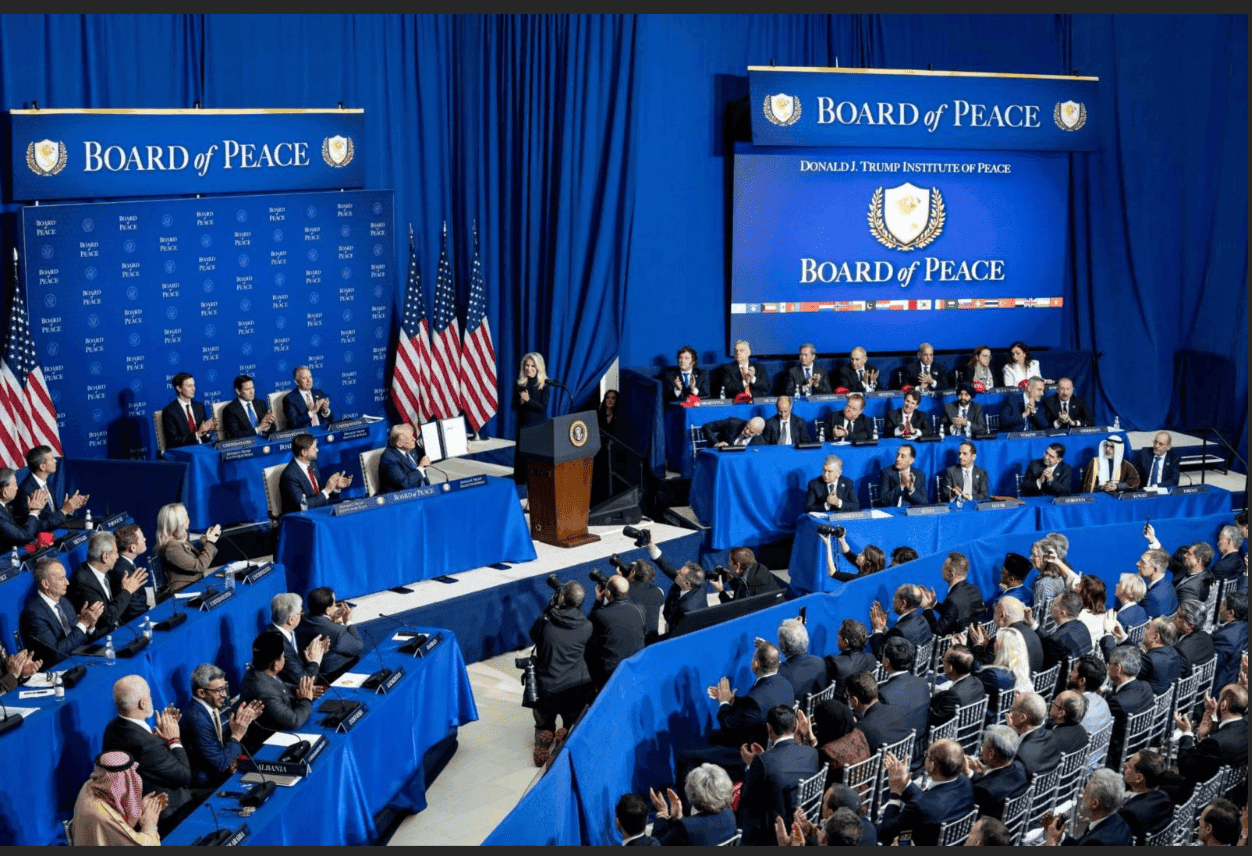
Out of the 60 invitees, 19 world leaders met on the sidelines of the World Economic forum in Davos, Switzerland, and signed their intent to join the Board of Peace. One month since its establishment, the Board’s inaugural meeting was held on February 19 at the Donald J. Trump Institute of Peace in Washington, DC. During his opening remarks, President Trump announced that several nations – Kazakhstan, Azerbaijan, United Arab Emirates, Morocco, Bahrain, Qatar, Saudi Arabia, Uzbekistan, and Kuwait – “have all contributed more than $7 billion toward the relief package.” While a good start, the UN and a co-report by the World Bank and EU estimate the total cost of Gaza’s reconstruction to be around $70 billion.
Following the conclusion of the Board meeting, Assistant of the President of the Republic of Azerbaijan Hikmet Hajiyev posted a clarifying statement that “In the future, Azerbaijan may consider participating in investment projects in Gaza through the Board of Peace. However,… Azerbaijan doesn’t envisage to participate in the USD 7 billion financial initiative related to Gaza that was announced [today].”
Later, the Commander of the International Stabilization Force (ISF), U.S. Army Major General Jasper Jeffers, stated that Kazakhstan, Indonesia, Morocco, Kosovo, and Albania have pledged to provide troops for the ISF. Egypt and Jordan have committed to training the new security forces. In total, 12,000 police officers and 20,000 soldiers will be sent to Gaza.
During their remarks, Kazakhstan President Tokayev and Uzbekistan President Mirziyoyev both stated that their countries will help rebuild civilian infrastructure in Gaza, such as residential complexes, houses, schools, and hospitals. Tokayev also stated that, as a global producer of wheat, Kazakhstan “is ready to provide humanitarian aid to enhance food security in Gaza.” He also announced plans to provide “500 scholarships to Palestinian students to pursue academic programs in [Kazakhstani] universities over a 5-year period” and to share Kazakhstan’s e-government and digital governance expertise. Armenia Prime Minister Pashinyan and Azerbaijan President Aliyev did not make statements during the meeting.
Although the specifics on how much Kazakhstan and Uzbekistan have committed monetarily and how many troops Kazakhstan will send are still unclear, it appears that the Caspian states are taking advantage of their newfound access to President Trump. The day before the Board’s meeting, President Mirziyoyev met with U.S. Secretary of Commerce Howard Lutnick and signed an agreement establishing a joint Investment Platform. A three-year Economic Cooperation Program worth $35 billion is also underway, covering key areas like energy, critical minerals, transport, agriculture, and information technology. In prior administrations, South Caucasus and Central Asia leaders would be lucky to get one bilateral meeting with a sitting U.S. president. The Board of Peace now provides these leaders with better access and opportunities. Additionally, with a set in the Board’s planning room, Caspian states are actively promoting their own industries and labor forces to participate in reconstruction efforts.