Russia’s New Migrant Labor Mechanisms Fall Short of Resolving Crisis
Recent Articles


Author: Dante Schulz
02/09/2021 · 4 min read

Russia recently approved a new mechanism to bring Central Asian workers to the country to cope with declining migration and a growing labor shortage. The Russian Ministry of Construction, Housing and Utilities is now permitting representatives from large Russian-owned construction firms to directly request the government to match migrant workers with their companies. Migrant workers from Kazakhstan, Tajikistan, Turkey, and Uzbekistan will be eligible to enter the country under the new regulations. This new mechanism will attempt to jumpstart cross-border travel and revive labor migration from Central Asia to post-pandemic levels after stringent lockdown measures froze most cross-border activities.
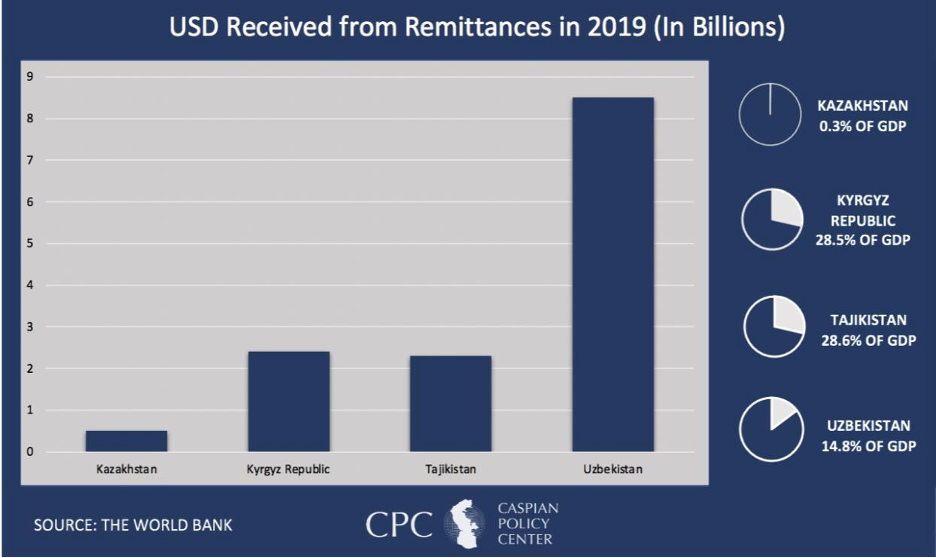
Many Central Asian countries suffer from oversaturated job markets and are unable to satisfy their domestic demand for work. In 2019, Tajikistan received $2.3 billion (28.6 percent of its GDP) in remittances, and Uzbekistan received $8.5 billion (14.8 percent of its GDP).
The initial outbreak of COVID-19 in the Caspian region prompted governments to swiftly close borders and discourage in-person activities. Central Asian migrant workers that had already embarked for Russia or that had already arrived in the country were left to endure the brunt of the lockdowns. Prior to the pandemic, the average salary in Russia was five times higher than that in Tajikistan and about twice as high than the Kyrgyz Republic and Uzbekistan. In general, migrant workers were more willing to work for lower wages compared to their Russian counterparts because of the dire economic situations in their home countries. However, after the COVID-19 pandemic forced migrants to crowd into communal housing, putting them at risk of contracting the virus, workers desperately flooded airports to gain a seats on limited repatriation flights. Furthermore, a study including Kyrgyz and Uzbek nationals conducted in April and May 2020 revealed that 75 percent of workers were furloughed or laid off while 50 percent lost all sources of income.
Central Asian migrants are also forced to endure an increasingly xenophobic environment in Russia. Over 75 percent of Russians support increasing limitations on labor migration; a growth of 25 percentage points since 2002. Similarly, the percentage of Russians who believe labor migration is beneficial to the country has plummeted from 44 percent to 16 percent in the same time frame. Russian news outlets have also been accused of “othering” migrant workers by depicting them as unwanted criminals. Uncertainties surrounding the COVID-19 pandemic, cramped living conditions that facilitate the spread of the virus, and poor treatment by their host country might indicate attitude shifts and desires to seek employment in other job markets abroad.
Central Asian migrants have already begun to seek employment in other countries. South Korea has become a popular destination for migrants from the region. For instance, the number of work visas South Korea issued to Uzbek citizens increased by 46 percent between 2016 and 2019. Predominantly Central Asian neighborhoods such as Seoul’s Wolgok-Dong are becoming more prevalent in major Korean cities. The European Union has also welcomed larger numbers of Central Asian migrants in recent years. The number of Tajik migrant workers receiving EU work visas spiked 190 percent between 2016 and 2019, while those receiving Russian work visas grew by only 41 percent. Turkey is also becoming a more attractive destination for Central Asian migrant workers. Ankara has put in place less restrictive policiestowards labor migrants, allowing applicants to avoid hurdles that draw out application processes in Russia. Moreover, Central Asian migrants are generally better received in Turkey than in Russia. Turkey’s booming construction sectorcontributed to the warm reception of migrants from Central Asia. However, regional turmoil, the COVID-19 pandemic, and economic downturn could foreshadow looming circumstances for migrants in Turkey.
Russia’s declining population is raising alarm among officials. For example, Russia’s population dropped by more than 500,000 people in 2020, the country’s most significant decline in 15 years. Russia must increase the number of immigrants in the country by 2.5 times to sustain its current population levels and increase the number of immigrants by 3.7 times to facilitate an increase. Currently, 80 percent of immigrants residing in Russia are citizens of the Commonwealth of Independent States (CIS), which include Kazakhstan, Kyrgyzstan, Tajikistan, and Uzbekistan. Russian officials are employing new strategies, such as simplifying the process for attaining legal status for migrant workers in the construction sector, to supplement its declining workforce and continue to be the primary destination for migrant workers in the region.
Russia’s decision to institute a new mechanism to allow migrant workers from Kazakhstan, Tajikistan, Turkey, and Uzbekistan to enter the country might fall short. The pandemic has revealed the dire living and economic situations migrants endure. Thus, the trend of Central Asian migrant workers choosing to find other host countries could increase despite the implementation of new regulations.