Catholics and Communists: Memory of Soviet Deportations in Polish-Kazakh Relations Today
Recent Articles
Author: Liam Gibson
08/27/2026
A crowd of people stands in the shadow of a bright white church looming up out of the steppe. Snippets of conversation in Polish, Russian, and Kazakh fill the air as villagers, Catholic clergy, and government officials from Poland and Kazakhstan gather to honor the suffering that transpired in Kazakhstan 90 years ago. An epitaph on a jagged black monument standing by the church proclaims in four languages, “Mary, Queen of Human Hearts, keep us in peace. To the Kazakh people from grateful Poles.”
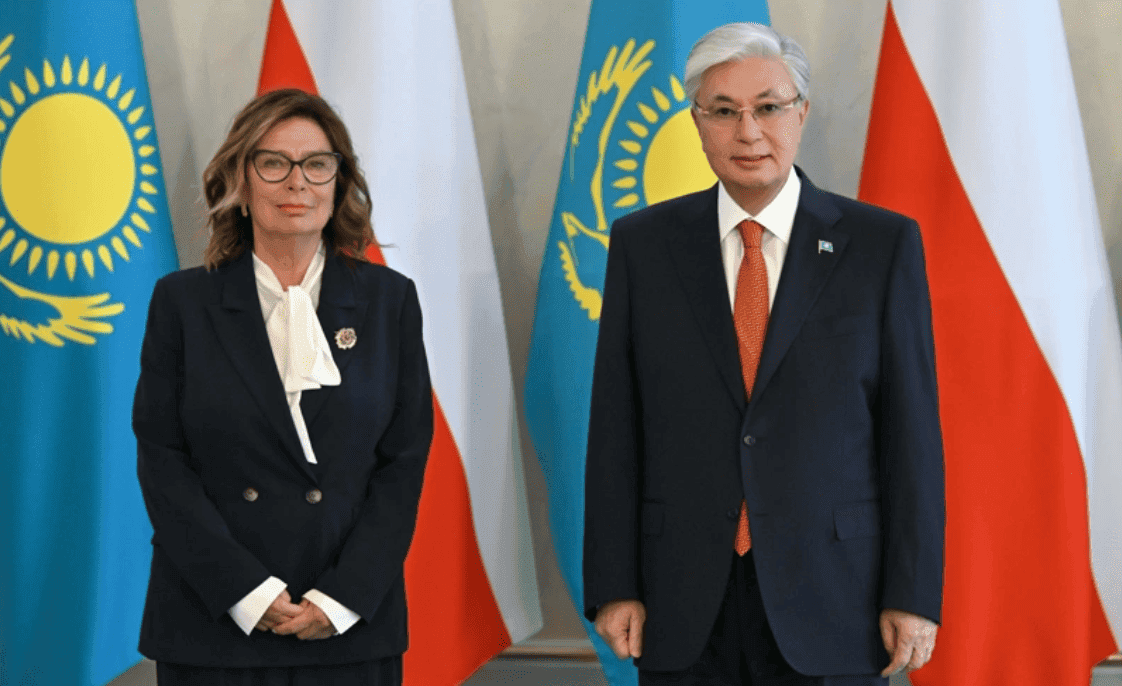
This scene took place on June 20 in the small settlement of Ozernoe, Kazakhstan, as Marshall of the Polish Senate Małgorzata Kidawa-Błońska completed an official visit to Kazakhstan. Besides meeting with President Kasym-Jomart Tokayev to expand an already $1.82 billion economic relationship and foster cooperation between the nations’ parliamentary bodies, she traveled to the village to participate in a memorial service for the 90th anniversary of the deportations.
Nearly a century ago, Polish deportees deemed untrustworthy by Joseph Stalin were scattered across northern Kazakhstan, building villages like Ozernoe. Many only survived the harsh conditions thanks to the generosity of the Kazakh nomads they encountered, who themselves suffered bitterly under Soviet rule. Although now home to fewer than 200 people, Ozernoe has become a major site of memorial to the deportations it was born out of. Today, this hard past is the bedrock of a robust relationship between Poland and Kazakhstan that encompasses trade, governance, and cultural diplomacy.
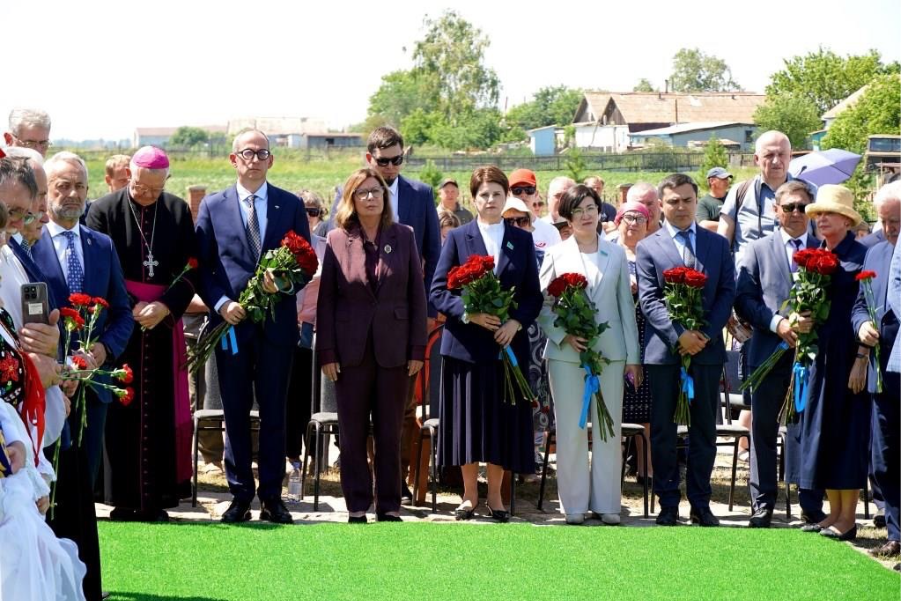
Marshall of the Polish Senate Małgorzata Kidawa-Błońska, center in burgundy pantsuit, Kazakh government officials, and Catholic clergy and faithful attending a memorial service in the village of Ozernoe, Kazakhstan, on June 20, 2026. Credit: https://catholic-kazakhstan.org.
Catholics, Communists, and the Mother of God
In 1936, Soviet authorities began the deportation of tens of thousands of Poles to northern Kazakhstan. Entire populations of villages were torn away from their homes in Ukraine and dumped on the frozen steppe, where many succumbed to hunger, disease, and exposure to the harsh elements. Those who survived often did so with the help of local Kazakhs, who had just suffered the Asharshalyk famine of 1930-1933 at the hands of the Soviet state. The Asharshalyk arose out of a ruthless collectivization campaign designed to destroy traditional nomadic ways of life. It claimed 1.5 million lives and scattered hundreds of thousands of Kazakhs to other parts of Central Asia, China, and Russia. Although the survivors found themselves destitute and a minority in their own land, they shared what little they had with the Polish deportees. The descendents of these exiles have not forgotten this compassion 90 years later.
Marshall Kidawa-Błońska and Kazakhstani government officials honored this heritage by participating in a memorial service that included speeches, a Catholic liturgy, and the dedication of the rugged monument mentioned above. The Catholic identity maintained by many descendants of the exiled Poles continues to define memory of another aspect of the deportations and is the source of Ozernoe’s enduring significance today.
Polish deportees arrived at Ozernoe in the summer of 1936, surviving the first winter in earthen dugouts carved out of the steppe. In 1941, when severe food shortages associated with the war effort afflicted the region, the Catholic Poles earnestly prayed the rosary, a prayer of devotion in honor of the Virgin Mary. As the snow began to melt, a lake filled with fish appeared in the steppe and sustained the village and other nearby settlements. The villagers understood this to be an answer to their prayers reminiscent of Christian miracles in the Bible. Today the site is home to the only Marian shrine in Central Asia, attracting a steady flow of Catholic pilgrims and international visitors.
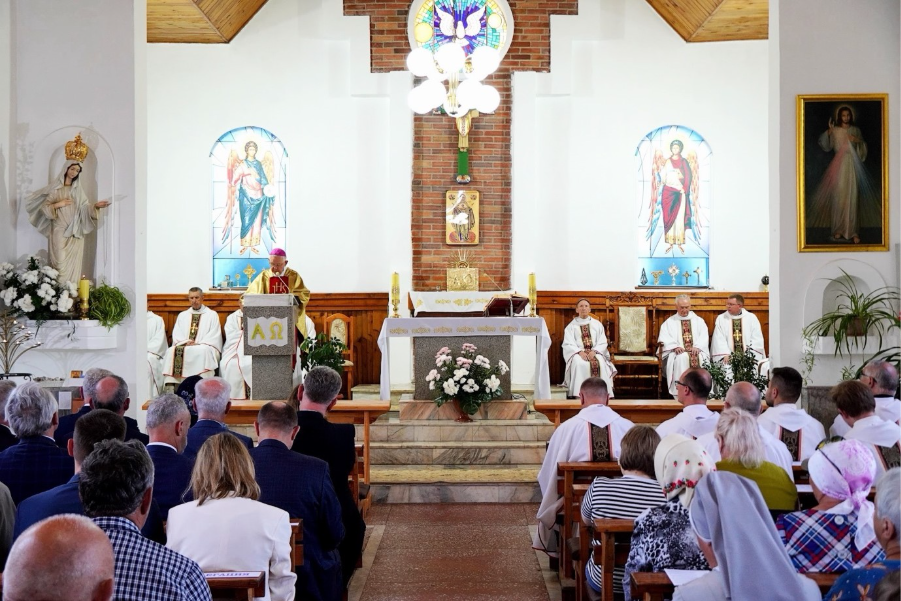
Archbishop Tomasz Peta presiding over the Catholic mass attended by Polish and Kazakh officials in Ozernoe, Kazakhstan, on June 20. Credit: https://catholic-kazakhstan.org.
Historical Foundation, Modern Impact
Archbishop Tomasz Peta’s journey to Kazakhstan stands in happy contrast to that of the deportees. Now serving as the Metropolitan of the Archdiocese of Mary Most Holy in Astana, the priest left Poland in 1990 to minister to Catholics in Ozernoe just after the believers there were granted permission to open a church. Hundreds of thousands of Catholics from many ethnic backgrounds worshiped illegally in the “Catacomb Church” of Soviet Kazakhstan. A small number of priests like Blessed Władysław Bukowiński, known as the “Apostol of Kazakhstan,” and, more often, elderly women preserved the Catholic faith in secret. Besides a temporary thawing of restrictions on religion following Stalin’s death, Catholics in Kazakhstan began to gradually receive official permission to worship starting at the end of the 1960s, with many believers practicing illegally until 1991. Although large numbers of Catholics emigrated to Germany and Poland in the wake of the Soviet collapse, clergy like Archbishop Peta still move to Kazakhstan to serve the remaining minority in a positive foil to the forced relocations of the Stalinist era.
At times, Kazakhstan’s Catholics have attracted attention from the highest levels of the Holy See. Pope John Paul II visited Kazakhstan in 2001, during which the Polish pope consecrated the nation to Our Lady of Ozernoe in front of a statue by the same name that now stands in the village. While in Astana in 2022, Pope Francis blessed an icon named “The Mother of the Great Steppe” that now resides in Ozernoe. Most recently, Auxiliary Bishop Evgeny Zinkovkiy of Karaganda presented the case for sainthood of Gertruda Detzel, a German deportee to Kazakhstan who spent five years in a Soviet prison for her faith, to Pope Leo XIV in October.
As for the large numbers of Polish clergy in the country today, Archbishop Peta emphasized that their mission is not limited to ethnic Poles but seeks to serve the universal Church in Kazakhstan, which includes Germans, Koreans, Kazakhs, and many other groups.
Faith and Foreign Policy
Religion and foreign policy often intersect, including during Marshall Kidawa-Błońska’s visit. Speaking to Polish and Kazakhstani government officials attending the liturgy at Ozernoe, Archbishop Peta highlighted the role played by the Kazakh people in saving many exiles. He stated, “Help rendered by the local population was one sign of God’s providence. Hundreds of witnesses attest to how the Kazakhs helped deportees. The local inhabitants, who themselves lived through great suffering and the extermination of their people, showed significant compassion, solidarity, and cordiality to the Poles and other peoples.”
When asked about the international legacy of this connection today, the archbishop explained, “The land became a second home for [descendants of deportees].… Many Poles emigrated to Poland or are preparing to repatriate, but their love for Kazakhstan remains [in their hearts], and this facilitates positive Kazakh-Polish relations.”
Relations are positive indeed. Poland is one of Kazakhstan’s most important EU partners, with trade turnover in agriculture, mining, medicine, technology, and finance reaching $1.82 billion in 2025. The June visit continued work begun during the 10th Polish-Kazakh Intergovernmental Commission for Economic Cooperation held in Astana in April. Despite the nearly $2 billion relationship, Kazakhstan maintains restrictions on certain products that also hamper Polish trade with Uzbekistan. Their removal was a central focus of the April meeting, and Marshall Kidawa-Błońska’s visit, underpinned by this historical connection, demonstrates continued resolve by both parties to expand their economic relationship in 2026.
The sides also discussed Kazakhstan’s upcoming parliamentary elections as it implements the new constitution ratified this March. Marshall Kidawa-Błońska met with Kazakh Senate Speaker Maulen Ashimbayev, who emphasized the importance of interparliamentary collaboration. Simultaneously, the Senate of the Republic of Poland held a meeting with Kazakh officials in Poland that might strengthen ties with pro-democracy institutions in Europe, perhaps in an attempt to downplay criticisms of Kazakhstan’s newly empowered executive branch. Regardless of the motivation, these efforts, too, rest on the historical solidarity between both nations’ forebears.
The robust relationship between Kazakhstan and Poland today is built on a shared memory of the compassion shown by the people of Kazakhstan 90 years ago. This unity, which provides the foundation for a strong economic partnership as well as a convenient point of access to the EU for Kazakhstan, remains perhaps the most positive legacy of the deportations today. Meanwhile, church steeples rising out of the steppe serve as stoic witnesses to the suffering that once soiled the land.