2025 Year-End Caspian Energy Review
Recent Articles
Author: Dr. Akbota Karibayeva Meyer
12/31/2025
 bp.com
A Region Under Pressure
Energy markets in the Caspian region came under intense and sustained pressure throughout 2025. Ukraine’s expanded drone campaign against Russia’s energy infrastructure created the most persistent shock. Dozens of refineries and storage sites were hit over the course of the year, at times sidelining up to 20 percent of Russia’s refining capacity. Because Central Asia still relies heavily on Russian refined products and import cycles, these disruptions quickly spilled across borders. Wholesale gasoline prices in the region jumped by more than 50 percent between January and August, and retail markets followed suit, especially in Kyrgyzstan, Tajikistan, and Uzbekistan. Even where bilateral supply agreements protected import volumes, the turbulence underscored how closely local fuel markets are tied to the stability—or instability—of Russia’s refining system.
Kazakhstan faced additional pressure from disruptions along the Caspian Pipeline Consortium (CPC) route, which carries roughly 80 percent of its crude exports. A Ukrainian drone strike on the CPC’s Kropotkinskaya pumping station in February forced a brief rerouting of flows. Russia then imposed “snap inspections” that reduced loading capacity at Novorossiisk to one Single Point Mooring (SMP) out of three—once again underscoring how deeply Kazakhstan’s export security depends on infrastructure outside of its control. In late November, a naval-drone attack damaged CPC’s SMP-2 offshore mooring at Novorossiisk. With SPM-3 already offline for scheduled maintenance, the loading capacity was reduced to 40 percent. CPC resumed limited shipments via the remaining operational mooring (SPM-1), while accelerating repairs to bring SPM-3 back online ahead of schedule, restoring capacity to just over half of normal levels. CPC warned that replacing the damaged unit could take months; two new Single Point Moorings (SPMs) under construction in Dubai will not be installable until well into 2026. Replacement costs—estimated at $80-120 million per mooring—add further financial strain, but even once repairs are complete, the offshore terminal could remain a high-value target in Ukraine’s campaign against Russian energy infrastructure, making repeated disruptions likely.
Azerbaijan entered the year facing a different kind of vulnerability. As Baku deepened its diplomatic engagement with the West—culminating in a U.S.-brokered peace agreement with Armenia—Moscow signaled its displeasure by hitting Azerbaijani energy assets abroad. Russia’s missile strike on a SOCAR-operated depot in Ukraine’s Odessa region on August 8––the very day the peace agreement was initialed––was widely read as a warning shot. Unconfirmed reports of an attack on Azerbaijani oil shipped to Romania added to the sense that energy infrastructure had become a venue for political messaging against Baku’s increasingly independent foreign policy.
Meanwhile, European demand dynamics continued to shift. The Trans Adriatic Pipeline (TAP) and the broader Southern Gas Corridor (SGC) delivered gas to 12 European countries in 2025—expanding from the initial three—and Azerbaijan pushed flows well above the pipeline’s initial design capacity. The Shah Deniz consortium also approved a $2.9 billion investment to boost output in line with 2030 export goals. And yet, even as Brussels reiterated its plans to stop all Russian gas imports by 2027-2028, European institutions hesitated to finance the next stage of SGC expansion. The EU’s decarbonization commitments have made long-term gas purchase agreements politically difficult, forcing Baku to consider pipeline expansion options that rely more heavily on Turkish financing and that might not reach European markets directly. This gap between geopolitical aspiration and the reality of regulatory constraint left Azerbaijan pursuing direct agreements with individual buyers, such as the massive Uniper AG agreement to supply Germany with a minimum of 1.5 bcm annually for the next decade. Despite the regulatory challenges, Azerbaijan’s president is clear: "Our main destination for natural gas is Europe.”
Domestically, pressures mounted across the region. Kazakhstan’s accelerating electricity deficit—projected to reach 25 gigawatts by 2035—became harder to ignore, especially as aging coal plants continued to operate at a wear and tear rate of 70 percent. Water shortages and extreme temperatures strained power systems across Central Asia and revived the urgency of long-discussed reforms in generation, grid modernization, and regional electricity trade.
Nuclear Ambitions
2025 did expose the region’s vulnerabilities but it also marked a decisive acceleration in efforts to reconfigure how the Caspian produces, refines, and exports energy. Kazakhstan moved forward with its nuclear energy program, following the 2024 national referendum. In June, the government selected Rosatom to build the country’s first nuclear power plant (NPP). The choice reflected three considerations: Rosatom’s extensive project delivery record; its ability to offer state-backed low-interest financing; and a fully integrated fuel cycle that aligns with Kazakhstan’s ambition to move up the nuclear value chain. To avoid overreliance on a single partner—and in line with its multi-vector approach—the government then announced that China’s CNNC would build the second and third NPPs. The broader strategy is now moving toward a nuclear cluster, mirroring the multiplier effects seen in Turkey’s Akkuyu project by stimulating local supply chains, technical education, and specialized industrial capacity.
Uzbekistan also deepened its nuclear ambitions, advancing its cooperation with Rosatom on six 55 megawatts small modular reactors (SMRs). In parallel, the U.S.-Uzbekistan presidential meeting in November signaled a new direction for collaboration: Uzbekistan expressed interest in purchasing SMRs from U.S. producers in the future. While no commercial orders have been placed, Tashkent signed an MOU with U.S. officials that opens a channel for U.S. vendors and gives Tashkent leverage and flexibility to draw on Western technology.
Expanding portfolios
On the other side of the Caspian, Azerbaijan deepened both sides of its energy portfolio. In hydrocarbons, SOCAR signed an agreement with ExxonMobil to explore unconventional onshore reserves, aimed at stabilizing output from maturing offshore fields. In parallel, SOCAR and BP kicked off construction of the 240-megawatt Shafag solar plant in Jabrayil, advancing Azerbaijan’s push to reach 6.5 gigawatts of renewable capacity by 2030. Downstream, Azerbaijan acquired Italiana Petroli (IP), one of Italy’s major refining and retail networks—a structural shift that positions SOCAR across the regional value chain at a moment when European supply margins are in flux.
In Central Asia, Tashkent advanced refinery upgrades and expanded gas-to-liquids capacity, strengthening domestic fuel security and enabling the production of aviation fuels and, soon, Euro-5 products previously imported at a premium. Kyrgyzstan and Tajikistan, still heavily import-dependent and exposed to Russian price volatility, moved ahead with small refinery projects—at Jalal-Abad, Kara-Balta, and Dangara—to build modest buffers that reduce dependence on Russia and China as well as future supply shocks. Turkmenistan continued relying on the Turkmenbashi and Seydi refineries and its gas-to-gasoline (GTG) plant at Ovadan-Depe, while also moving ahead with plans for a second Japanese-Turkish GTG facility. The high-profile July visit by Gurbanguly Berdimuhamedow to Baku—paired with renewed cooperation around the mid-Caspian Sea Dostluk field—signaled a broader realignment built on shared export interests, complementary infrastructure needs, and increasingly aligned political systems. No pipeline commitments were announced, but the tone of the visit suggested that Ashgabat is now more open to diversified export routes than at any time in the past decade.
Alternative Routes
This shift coincided with a resurgence of interest in the long-stalled Trans-Caspian Pipeline concept. U.S. Senator Steve Daines and Secretary of State Marco Rubio’s exchange at a Senate Foreign Relations Committee hearing in May pushed the issue back onto Washington’s agenda, giving political cover to regional conversations about a Turkmenistan-Azerbaijan interconnector long blocked by Turkmenistan’s reluctance and Russia’s opposition. The geopolitics have changed: Europe is moving rapidly to eliminate Russian gas; Turkmenistan is increasingly wary of its overdependence on China; and Türkiye seeks to consolidate its position as a regional gas hub. An interconnector would not unlock the full scale of Turkmen exports, but it would serve as a proof of concept that could de-risk future infrastructure decisions.
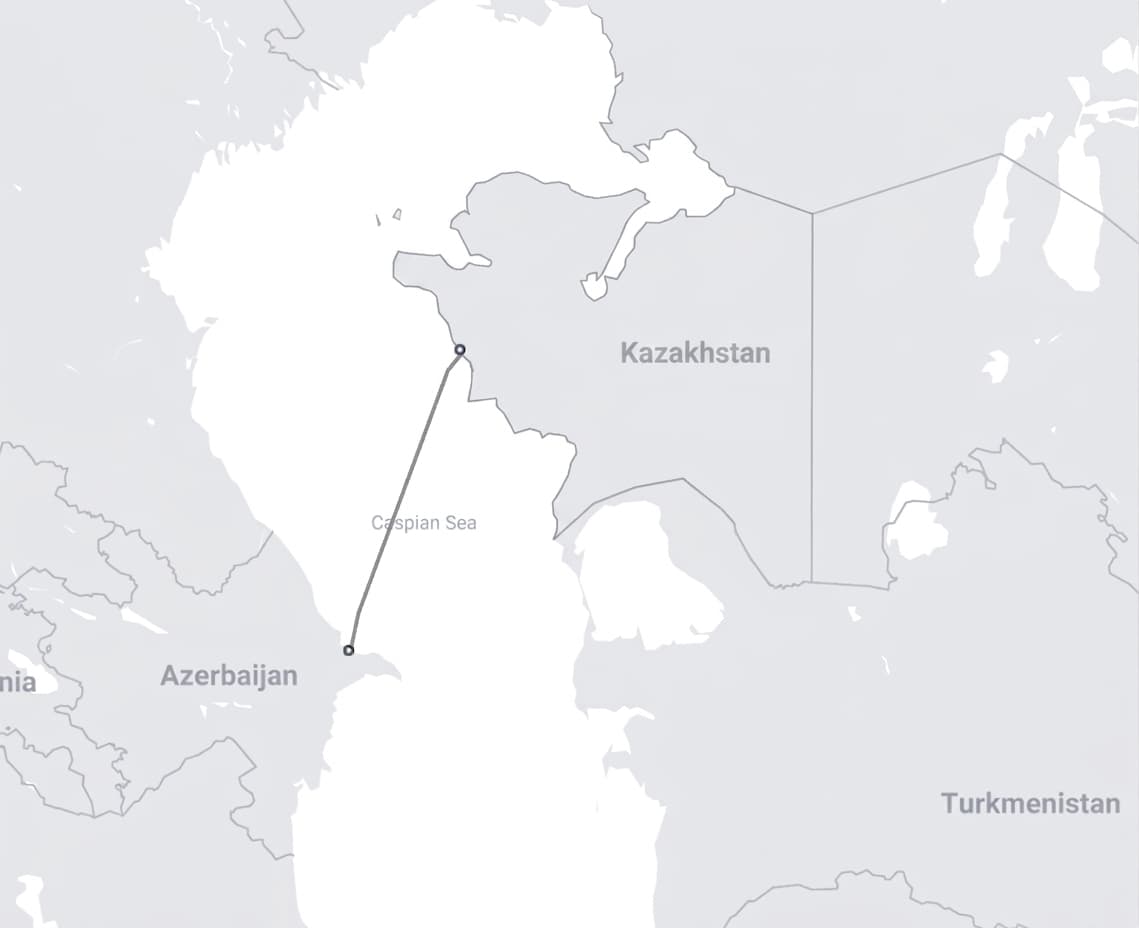
Oil and gas transit corridors also continued to evolve. Kazakhstan expanded its modest but steadily growing volumes shipped across the Caspian to Baku for onward transit through the Baku–Tbilisi–Ceyhan pipeline, recording a 12 percent increase in the first half of 2025. While nowhere near CPC scale, the growth reflects a deliberate strategic hedge: cultivating alternatives to Russian routes while reinforcing the Caspian Sea’s emerging role as a genuine east-west energy interface. For Azerbaijan and Georgia, these additional Kazakh volumes strengthened efforts to turn the Middle Corridor into a commercially credible transit system.
Regulatory and Governance Crosswinds
In Kazakhstan, the government intensified its use of formal legal tools to reshape fiscal terms, enforce environmental compliance, and increase leverage over international operators ahead of expiring production-sharing agreements (PSAs). The August appellate court ruling overturning the $4.2 billion sulfur-storage fine against the North Caspian Operating Company (NCOC) eased immediate tensions with foreign partners but did not soften the government’s broader posture. The far larger $160 billion arbitration against NCOC remains active—alleging aggressive cost-recovery practices, misreported recoverable costs, and the misuse of funds for bribery schemes.
To pursue this case further, Kazakhstan widened the legal battlefield. In Switzerland, it filed a $15 million lawsuit against Eni subsidiaries linked to alleged 2006-2011 procurement and bribery schemes. In the United States, a federal court authorized the deposition of former KMG and Eni executive Maksat Idenov, even as it dismissed several discovery applications aimed at securing internal Eni records. These multi-jurisdiction efforts—combined with rolling compliance demands inside Kazakhstan—demonstrated that Astana is increasingly treating legal processes as a central instrument of resource governance rather than a last resort. The consequence for investors is a more formalized and rules-based landscape, but also one where governments appear more willing to deploy legal mechanisms to correct what they view as structural imbalances in legacy resource agreements.
A Silent Threat
A long-term threat looming quietly over all these efforts is the accelerating decline in Caspian Sea levels. The sea has fallen roughly 0.75 meters since 2022 and about 2 meters since 2006, with projections showing potential declines of up to 18 meters by the end of the 21st century. For a region whose offshore platforms, coastal pipelines, refineries, and port infrastructure were built for a higher shoreline, the implications are profound. Lower water levels mean higher dredging costs, seasonal access constraints, infrastructure retrofits, and rising insurance premiums. For Kazakhstan and Azerbaijan in particular, the trend threatens both the physical integrity of offshore operations and the commercial viability of Caspian shipping—an essential component of their diversification strategies. In the coming years, this slow-moving variable may prove more consequential than short-term geopolitical shocks.
Taken together, 2025 pushed the Caspian energy system out of its comfort zone. External shocks exposed just how much regional prosperity still rides on infrastructure and policy choices far beyond local control. At the same time, European demand is shifting under the twin pressures of decarbonization and Russian disengagement, creating demand signals but little long-term certainty. The region enters 2026 more interconnected, more ambitious, and more exposed than before – caught between the opportunity to rewire its role in global energy markets and the risk that external shocks and environmental challenges will outpace its ability to adjust.