Caspian Policy Center (CPC) Releases Two New Reports on Security and Infrastructure of the Greater Caspian Region
Recent Articles


Author: Caspian Policy Center
02/11/2019 · 4 min read
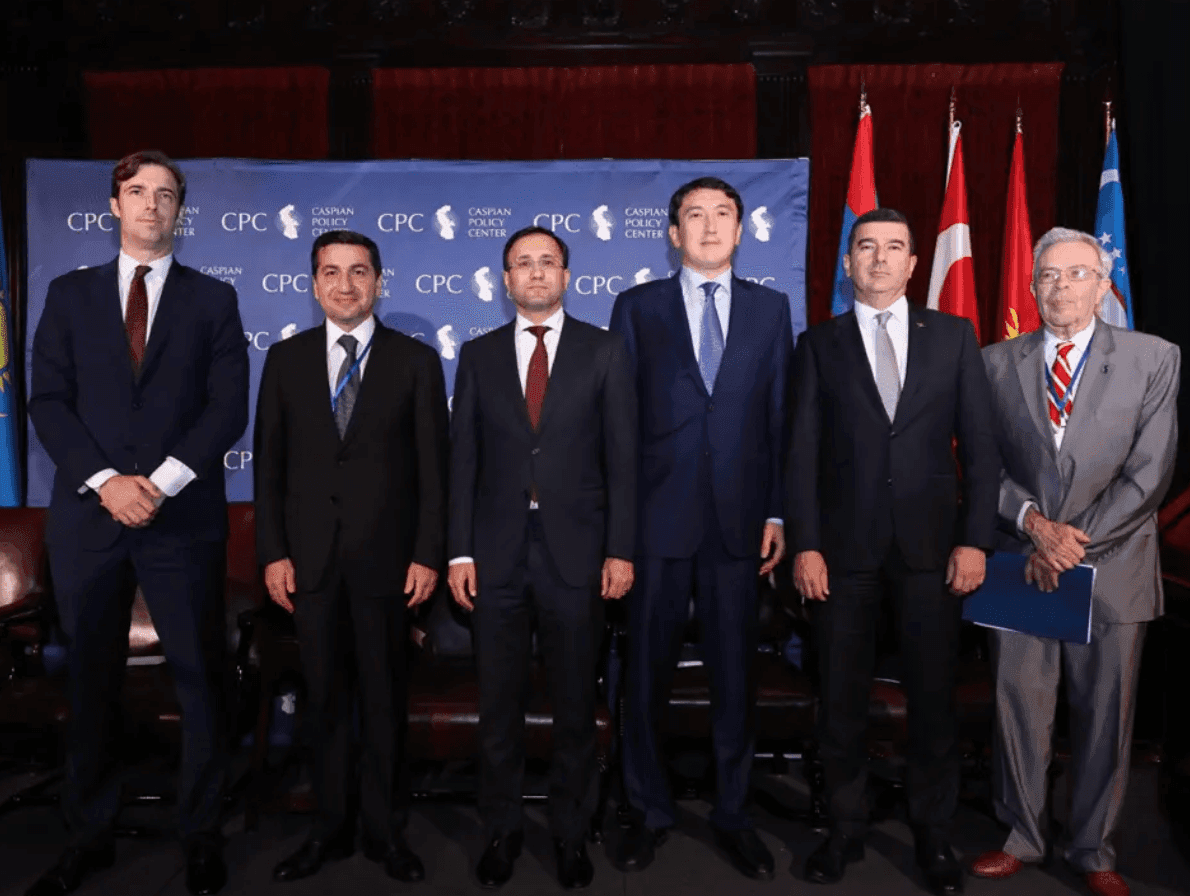
Left to right: Efgan Nifti, Executive Director, Caspian Policy Center, Ambassador (Ret.) Richard E. Hoagland, Caspian Politics and Security Program Chair and Board Member, Luke Coffey, Board Member, and Ambassador Robert F. Cekuta, Caspian Energy and Economy Program Chair and Board Member at the Caspian Policy Center. WASHINGTON, D.C. — The Caspian Policy Center today announced two new reports that take a more in-depth look at the Greater Caspian Region and its strategic importance for the United States: the Caspian Security Project and Protection and Modernization of Critical Infrastructure – Key to Prosperity and Safety. The Caspian Security Project, authored by the CPC Board Member and former Ambassador Richard E. Hoagland, is a collection of essays by diplomatic, military, and academic experts designed to educate about the region. The report looks at U.S. policy in the Caspian region over the past quarter century and suggests where the United States should pay particular attention to in the coming years. “The Caspian Policy Center continues to raise its profile in the U.S. foreign policy community with this essential new study of the Greater Caspian Region where Russian, Chinese, American, and European interests converge on a geographic ground-zero,” said Ambassador (Ret.) Hoagland, Caspian Politics and Security Program Chair at the Caspian Policy Center. “Foreign affairs commentators and implementers will welcome the policy recommendations this report includes.” The second report launched by CPC - Protection and Modernization of Critical Infrastructure – Key to Prosperity and Safety - focuses on the threats facing the infrastructure systems in the Caspian and the need for increased regional cooperation with the United States and other western partners. Penned by the former U.S. Ambassador to the Republic of Azerbaijan and CPC Board Member Robert F. Cekuta, the study unfolds how governments and the private sector need to work together, to monitor electrical, information technology, transportation, and other critical infrastructure systems to ensure their integrity as well as the prosperity and well-being of the public, and the security of the countries of the region. “Billions of dollars are being spent each year on building roads, ports, IT and communication systems, electrical grids, and other infrastructure in the Greater Caspian Region,” said Ambassador (Ret.) Cekuta, Caspian Energy and Economy Program Chair at the Caspian Policy Center. ”Protecting and maintaining that infrastructure is just as important as building it." The Greater Caspian Region includes the now-independent former Soviet Republics of the South Caucasus and Central Asia. These countries are Armenia, Azerbaijan, Georgia, Kazakhstan, Kyrgyzstan, Tajikistan, Turkmenistan, Uzbekistan, and Afghanistan which has historically always been considered a part of Central Asia. The region is generally not front-burner for U.S. foreign-policy makers because, it is relatively stable despite the post-Soviet prolonged conflicts in Georgia (Abkhazia and South Ossetia) and between Armenia and Azerbaijan (Nagorno-Karabakh). Major new infrastructure projects are underway in this region, totaling billions of dollars annually that include building and updating energy, transportation, IT, and other systems across the region. As the new Silk Road, BRI, Lapis Lazuli Corridor, and other links develop connecting the West with China and Central and Southern Asia, the United States and Western Europe have a strategic interest in the integrity of these systems. More information about the reports is available here. The Caspian Policy Center (CPC) is an independent, nonprofit research think tank based in Washington D.C. Economic, political, energy, and security issues of the Caspian region constitute the central research focus of the Center. CPC aims at becoming a primary research and debate platform in the Caspian region with relevant publications, events, projects, and media productions to nurture a comprehensive understanding of the intertwined affairs of the Caspian region. With an inclusive, scholarly, and innovative approach, the Caspian Policy Center presents a platform where diverse voices from academia, business, and policy world from both the region and the nation’s capital interact to produce distinct ideas and insights to the outstanding issues of the Caspian region. [caption id="attachment_8040" align="alignnone" width="300"] Ambassador (Ret.) Robert F. Cekuta[/caption] [caption id="attachment_8036" align="alignnone" width="300"]
 Left to right: Ambassador (Ret.) Richard E. Hoagland, Ambassador (Ret.) Robert F. Cekuta, and Kristen Cheriegate, Program Manager at the Caspian Policy Center[/caption] [caption id="attachment_8038" align="alignnone" width="300"]
 Left to right: Luke Coffey, CPC Board Member and Ambassador (Ret.) Robert Cekuta[/caption]