President of Georgia Visits Azerbaijan


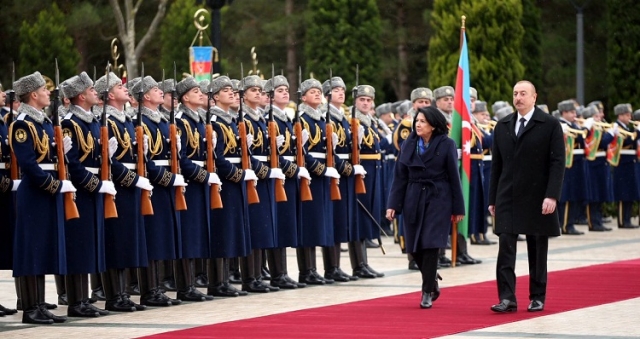
Georgian President Salome Zurabishvili visited Azerbaijan on February 28, her first trip to the country since taking office. President Zurabishvili met with Azerbaijani President Ilham Aliyev as well as his wife, Vice President Mehriban Aliyeva.
Her discussion with President Aliyev raised heads when she compared the Nagorno-Karabakh conflict to violence in Georgia’s Abkhazia and South Ossetia regions. President Zurabishvili said that “in recent years, we have gone through similar tragedies. We are now experiencing what it means for our country’s territories to be occupied—what it means to have our country’s territorial integrity violated.” Historically, Georgia has avoided taking a side on the Nagorno-Karabakh conflict, in which its Caucasian neighbors—Armenia and Azerbaijan—are on opposite sides.
Issues surrounding the conflict have drawn anger from Azerbaijan in the past. Just last month, Georgia’s Akhalkalaki region erected a monument to an Armenian soldier who fought in Nagorno-Karabakh. The Armenian Ambassador to Georgia participated in the ribbon-cutting ceremony. Local Georgian officials and some MPs of the ruling Georgia Dream party attended the event. Some Azerbaijani media outlets criticized the monument. One MP, Rasim Musabekov, called it a “provocative action” that “will not add warmth to the relationship between Azerbaijan and Georgia.”
However, rifts like these are the exception, not the rule, in Azerbaijani-Georgian relations. As President Aliyev noted in his remarks, Azerbaijan and Georgia have cooperated on massive energy initiatives such as the Baku-Tbilisi-Ceyhan pipeline and on transport projects like the Baku-Tbilisi-Kars railroad.
President Zurabishvili’s meeting with Vice President Aliyeva reflected her desire to add culture to the list of areas of Azeri-Georgian collaboration. Their dialogue focused on strengthening cultural relations and promoting cultural heritage between the people of Azerbaijan and Georgia. Zurabishvili spoke particularly on the issue of tolerance, a feature she is lobbying to have included in the UNESCO list of intangible cultural heritage of Georgia. In her meeting with Aliyeva, she noted that this tolerance is a trait common to the Caucasian nations, but one which “the modern world lacks.” In more concrete terms, the two countries are opening a direct flight route between Baku and Batumi in June and holding Azerbaijan Culture Days in Batumi and Tbilisi around the same time.
President Zurabishvili took office in December, and this trip to Baku is one of her first international visits. Her warm welcome along with the constructive dialogue between herself and the Azerbaijani heads of state cements the cordial relationship between the two countries. Prioritizing a trip to Azerbaijan, remarking on the similarities in their struggles for sovereignty, and advocating a closer cultural connection all indicate the Zurabishvili administration will continue close cooperation with their eastern neighbor.