U.S. Congress Affirms Support for Southern Gas Corridor
Recent Articles


Author: Caspian Policy Center
12/13/2018 · 6 min read
Congress passed the bipartisan House Resolution 1035 (Expressing Opposition to the Completion of Nord Stream 2, and for other Purposes) on December 11 that promotes the Southern Gas Corridor, while calling for European governments to reject the Nord Stream 2 project. The resolution supported European energy security through diversification of supplies, such as the Southern Gas Corridor which will deliver Caspian Sea energy resources to Southern and Central Europe. The exact text read as follows: “Expressing opposition to the completion of Nord Stream II, and for other purposes. […] Whereas it has been longstanding United States policy to support European energy security through diversification of supplies, such as the Southern Gas Corridor which will deliver Caspian Sea energy resources to Southern and Central Europe.” The legislation had the support of 36 cosponsors, and passed in the House unanimously. The following was resolved by the Representatives:
(1) finds that Nord Stream 2 is a drastic step backwards for European energy security and United States interests;
(2) calls upon European governments to reject the Nord Stream 2 project;
(3) urges the President to use all available means to support European energy security through a policy of diversification to lessen reliance on the Russia Federation; and
(4) supports the imposition of sanctions with respect to Nord Stream 2 under section 232 of the Countering America’s Adversaries Through Sanctions Act (22 U.S.C. 9526).
The non-binding resolution affirms support for the SGC, which will bring Caspian supplies to Europe by 2020.
The Projects:
Southern Gas Corridor The Southern Gas Corridor (SGC) started out as a European Commission initiative to supply natural gas from the Caspian region and the Middle East to Europe. The SGC is comprised of three separate pipelines: the South Caucasus Pipeline, the Trans-Anatolian Pipeline, and the Trans-Adriatic Pipeline. The South Caucasus Pipeline (SCPX) spans from Azerbaijan to Georgia; the Trans-Anatolian Pipeline (TANAP) reaches across Turkey; and the Trans-Adriatic Pipeline (TAP) covers Greece, Albania, and Italy. The SGC stretches over 3,5000 kilometers, and will be pulling oil from the Shah Deniz Field which was discovered by BP in 1999.  Nord Stream 2 Nord Stream 2 is an export gas pipeline which runs across the Baltic Sea from Russia to Europe (see image). The point of entry in the Baltic Sea will be in the Leningrad Region — specifically the Ust-Luga area. After traveling across the Baltic Sea, the exit point is in the Greifswald area of Germany; this will put the exit point near that of Nord Stream. Transporting 55 billion cubic meters of gas per year, the project’s two strings stretch just over 1,200 kilometers. The project is projected to be operational before late 2019.

CPC Expert Reactions:
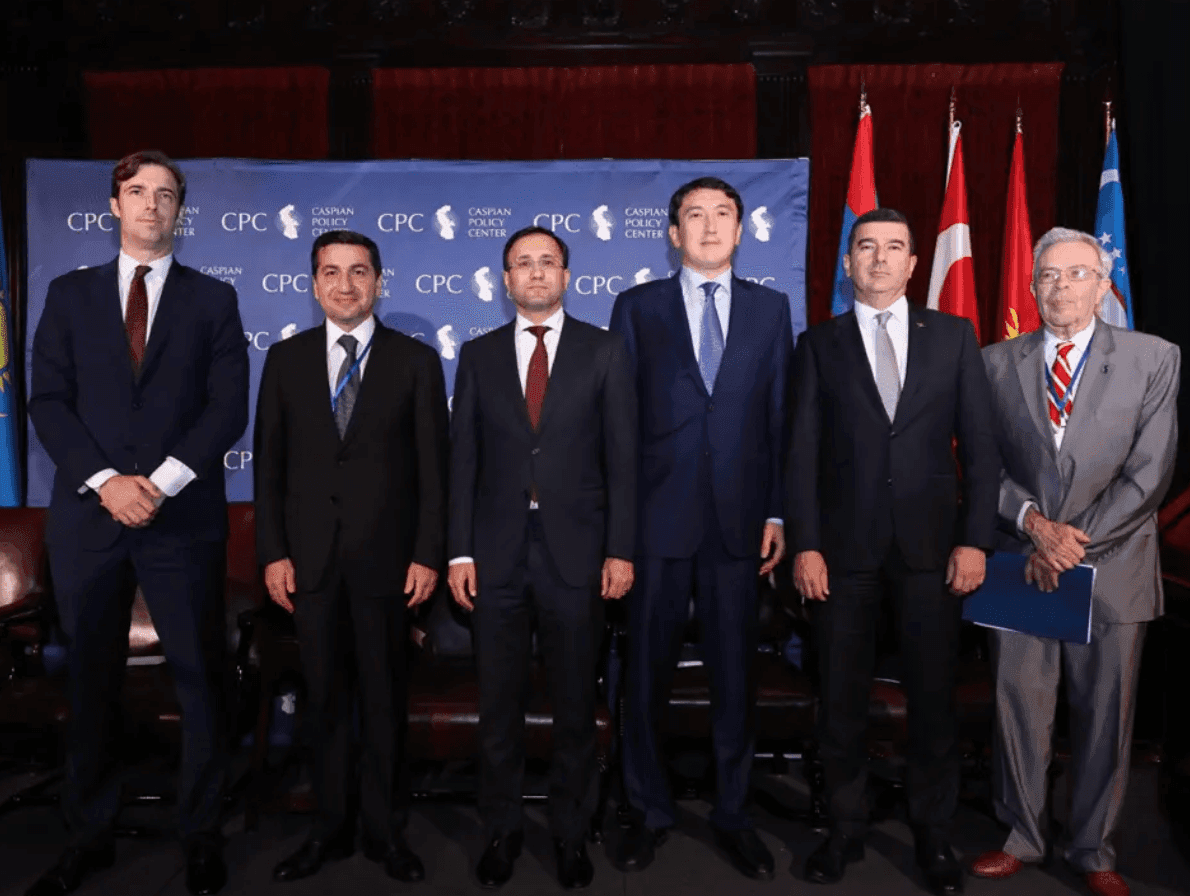
“The House resolution is a powerful sign of how solid the U.S. position is regarding the problems with Nord Stream 2, and the benefits of projects like the Southern Gas Corridor. Nord Stream 2 undercuts Ukraine; it undercuts European and global energy security. However, threatening NATO allies with sanctions is unfortunate. We should be able to engage and win their agreement through diplomacy and the respect that comes from years of close cooperation and friendship.” -Ambassador (ret.) Robert Cekuta, Advisory Board Member, Caspian Policy Center "The Southern Gas Corridor is a very significant contribution to the security of supply of energy to Europe all the way from Azerbaijani fields in the Caspian Sea. Together with Azerbaijan and its international partners, U.S. support for the project has been key in materializing the project. The recent affirmation of support by U.S. Congress is further cementing U.S. commitment to the realization of the SGC.” - Efgan Nifti, Executive Director, Caspian Policy Center
Analysis:
The resolution is somewhat reactionary to recent events. On one hand, Russia controls almost 40 percent of Europe’s gas, and multiple countries rely on Russian gas for at least 75 percent of their annual needs. On the other, Ukraine’s existing gas transit system has an equal capacity to the project’s estimated outcome (55 billion cubic meters). On December 6, Assistant to the President of the Unites States for National Security John Bolton acknowledged that Washington is considering a wide range of actions that can stop the project’s construction. During an interview with Wall Street Journal managing editor Gerard Baker, Bolton said, “Well, there are a lot of sanctions that are already in place against the Russians, more could come. The president has repeatedly said, for example, [that] Germany should cancel the Nord Stream 2 gas pipeline, that we are looking at a variety of things we could do there.” Many critics of the legislation have been calling for the United States to take a step back from Nord Stream 2. In June 2018, Germany was assured by U.S. officials that Russian sanctions would have no effect on the gas pipeline’s construction. A spokesman for the U.S. embassy in Berlin also said there had been no change in policy at that time. “We have been clear that firms working in the Russian energy pipeline sector are engaged in a business that carries sanctions risk.” However, the resolution in the legislation supports the introduction of sanctions against its construction under the Countering America’s Adversaries Through Sanctions Act. The document is purely declarative, and its provisions are optional. The Atlantic Council’s Global Energy Center and Eurasia Center hosted a debate on March 12 to discuss the merits and risks the project poses. Whether or not to move forward with Nord Stream 2 “is a decision that has massive geopolitical import,” according to Sandra Oudkirk, Deputy Assistant Secretary of State for Energy Diplomacy at the U.S. Department of State’s Bureau of Energy Resources. Oudkirk acknowledged that the project also causes the United States many concerns. “Because it has such a potentially large impact on the national security of some of our largest partners in the world, it has an impact on our national security,” she noted. The resolution is solely a symbolic resolution, and requires no further action. However, this is a sign that the United States remains a steadfast supporter of enhancing Europe’s energy security through the utilization of the Southern Gas Corridor. In June 2013, Representative Michael Turner introduced House Resolution 284 to the 113th Congress (Expressing the Sense of the House of Representatives with Respect to Promoting Energy Security of European Allies through Opening up of the Southern Gas Corridor). The text affirmed that it is the policy of the United States in the countries of the South Caucasus and Central Asia to assist in the development of infrastructure necessary for energy and trade on an East-West axis in order to build strong international relations and commerce between those countries. The legislation was last forwarded by the Subcommittee on Europe, Eurasia, and Emerging Threats to the full committee (amended) by unanimous consent in September 2013; unfortunately, it was never voted on. The resolution, if passed, would have resolved the following: (1) the House of Representatives—
(A) notes that further energy exploration in the Caspian Sea region will enhance energy security of European allies;
(B) affirms that it is in the national interest of the United States to support and enhance Europe’s energy security by opening up the Southern Gas Corridor; and
(C) encourages the Administration to continue to actively engage with the Governments of Azerbaijan, Turkey, Georgia, and other regional partners to provide support for new and ongoing projects; and
(2) it is the sense of the House of Representatives that it is in the national interest of the United States to support and enhance Europe's energy security by working with the Governments of Turkey, Azerbaijan, and Georgia and its partners to make available additional gas and oil supplies to that market in a cost effective and secure manner.