Central Asian countries adopt declaration on countering terrorism
Ministers of Kazakhstan, Kyrgyzstan, Tajikistan, Turkmenistan and Uzbekistan adopted a joint declaration on strengthening regional collaboration to counter terrorism, the United Nations Regional Centre for Preventive Diplomacy for Central Asia (UNRCCA) said in a message.
The document was signed in Ashgabat at a meeting of the High-Level United Nations-Central Asian Dialogue on Implementing the United Nations Global Counter-Terrorism Strategy in Central Asia, chaired by the UN Secretary-General Antonio Guterres.
The objective of the meeting was to review progress on implementation of the Joint Plan of Action for the UN Global Counter-Terrorism Strategy in Central Asia and to define future strategic counter-terrorism priorities for the region.
Guterres reiterated the readiness of the UN to continue supporting regional and national efforts of Central Asian countries in fighting terrorism.
UN to continue supporting Central Asia countries in countering terrorism
“Central Asian countries are leading by example in the joint implementation of the United Nations Global Counter-Terrorism Strategy at the regional level,” commended Mr. António Guterres adding that the Joint Plan of Action for Central Asia is the first of its kind around the world. The Secretary-General also noted that “policies that limit human rights only end up alienating religious and ethnic communities, who would normally have every interest in fighting extremism.”
The Secretary-General also expressed his appreciation to the Central Asian countries for their “commitment to jointly addressing and defeating the scourge of terrorism” and for further strengthening regional cooperation and coordination in this field. “No one country can defeat terrorism alone,” Mr. António Guterres said. He also reiterated the readiness of the United Nations to continue supporting regional and national efforts of Central Asian countries in this regard. He added that his counter-terrorism architecture reform initiative to establish a new Office of Counter-Terrorism “will provide stronger leadership, enhance coordination and coherence across the system, strengthen capacity building support, mobilize political will and robust partnership to ensure a balanced implementation of the United Nations Global Counter-Terrorism Strategy.”
Azerbaijan, several CIS countries sign customs co-op agreements
Azerbaijan has signed a number of bilateral agreements on customs cooperation with the CIS countries.
The signing ceremony was held in Baku as part of the 65th meeting of the heads of the customs bodies of the CIS countries.
The Azerbaijani State Customs Committee signed agreements with customs bodies of Russia and Kyrgyzstan.
The protocol on the exchange of preliminary information on goods and vehicles between the Azerbaijani State Customs Committee and the Federal Customs Service of Russia was signed by Aydin Aliyev, head of the Azerbaijani State Customs Committee, and Vladimir Bulavin, chairman of the Federal Customs Service of Russia.
The protocol on cooperation in vocational training and professional development of personnel between the Azerbaijani State Customs Committee and the Kyrgyz State Customs Service was signed by Aydin Aliyev, head of the Azerbaijani State Customs Committee, and Azamat Suleymanov, head of the Kyrgyz Customs Service.
Moreover, a protocol on cooperation and mutual assistance, as well as a protocol on the procedure for interaction in comparing the data of customs statistics on mutual trade between Uzbekistan and Tajikistan were signed.
Russia might participate in CASA 1000 project — Energy Minister of Afghanistan
Russia expressed wish to participate in CASA 1000 power project, Minister of Energy and Water of Afghanistan Ali Ahmad Osmoni said on the sidelines of the EXPO 2017 international exhibition.
According to him, the Afghan Ministry received a letter from the Russian Deputy Minister of Energy.
"We got a request from the Russian side about its intentions to participate in implementation of the CASA 1000 project, which envisages power flow from Central Asia to South Asia," the Minister noted.
"Russia plans to participate in the export of electricity to South Asia as it has its Sangtituda HPP-1 in Tajikistan," Ali Ahmad Osmoni said.
Implementation of the CASA 1000 project will allow Tajikistan and Kyrgyzstan to export 1,300 MW of electricity to Afghanistan and Pakistan every year. The project aims to export the power surplus from these two countries in summer period.
The project is expected to finish by 2020. The project costs more than $1 billion, including $314 mln — Tajikistan, $209 mln, $354 mln — Afghanistan, $209 mln — Pakistan.
UN calls for transition towards clean energy at Expo 2017 in Kazakhstan
At the EXPO 2017 on “Future Energy” in Astana in Kazakhstan, on June 13, the United Nations called on governments, businesses, and cities to increase their efforts to accelerate the transition towards clean energy.
“We are confident that the EXPO will give a new momentum to the ongoing efforts to achieve the Sustainable Development Goals. I hope the EXPO will advance dialogues between governments, climate scientists and engineers to find practical solutions for reducing greenhouse gas emissions while generating energy,” said Cihan Sultanoğlu, the UN’s Commissioner-General for the Expo 2017 in Astana.
“Energy is the most critical sector for addressing climate challenges. Energy sector transformation is therefore critical for countries to achieve their climate and development goals and objectives,” stressed Ms Sultanoğlu. “We need to maintain, strengthen and support the transition in all possible ways,” she added.
UN ready to support economic projects in Central Asia
President of Turkmenistan Gurbanguly Berdimuhamedov met with UN Secretary-General Antonio Guterres, who arrived in Ashgabat as part of his Central Asia tour.
During the meeting held with the participation of the delegations of Turkmenistan and the United Nations, the Turkmen leader underlined the particular significance of the visit of the UN Secretary-General in the framework of the 25th anniversary of Turkmenistan's membership in the United Nations, celebrated this year, the press service of the president said in a statement.
Guterres thanked Turkmenistan for assistance it gives to refugees and stateless persons and assistance to Afghanistan. He particularly emphasized the construction of a railway and social projects.
In addition, António Guterres highly appreciated the initiative of President Gurbanguly Berdimuhamedov to provide a platform for talks between representatives of different forces in Afghanistan to resolve the situation in the country. The UN Secretary-General stressed that the United Nations fully supports and welcomes the proposal and efforts of Turkmenistan to restore peace in Afghanistan.
Guterres said that the UN is ready to cooperate with the countries of Central Asia in the economic fields. He noted that one of the key problems in the world is water issue, and the region has opportunities for the solution of this problem. The region has many opportunities to develop trade, encourage investments, support the construction of infrastructure and create common conditions for solving the water crisis.
The UN is always ready to offer its assistance and support water, energy and infrastructure projects, as well as the creation of various trade mechanisms, tariffs, tax systems that can bring great benefits to development of the peoples of this region, the UN Secretary General said.
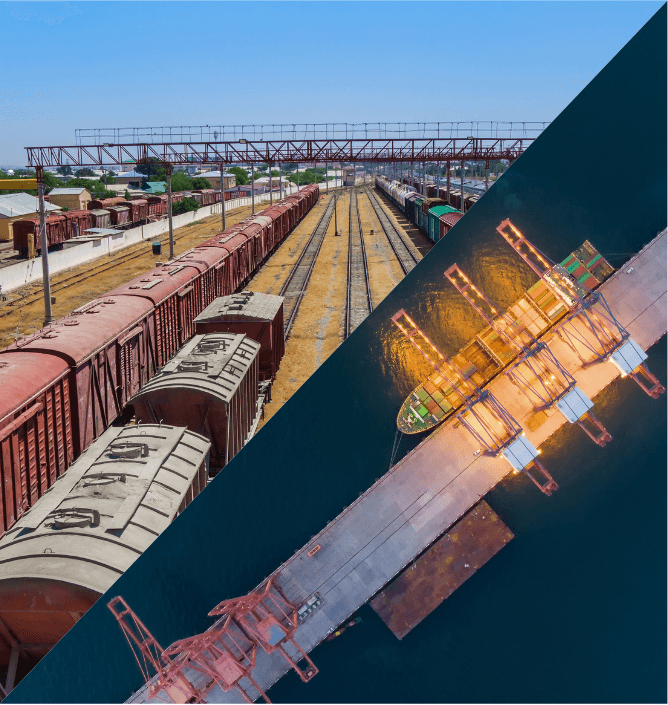
Kerry Logistics Expands Multimodal Freight Network Through Forming a Joint Venture in CIS
Kerry Logistics Network Limited continues to enhance its services and network under the 'Belt and Road' Initiative by entering into a joint venture through participating in the equity of Globalink Logistics DWC LLC, a freight forwarding group headquartered in Dubai with operations spanning across The Commonwealth of Independent States ('CIS'). The move will significantly expand Kerry Logistics' coverage in Central Asia and the CIS, opening the door to potential markets with tremendous growth prospects.
The partnership will see nine countries added to Kerry Logistics' global network. They include Kazakhstan, Uzbekistan, Kyrgyzstan, Tajikistan, Turkmenistan, Georgia, Armenia, Azerbaijan and Ukraine. Leveraging the booming trade between China and Europe, Kazakhstan, in particular, is expected to benefit most from the increasing transit cargo flow along the trade lanes.
William Ma, Group Managing Director of Kerry Logistics, said, "We are very excited about this joint venture, which is part of our development strategy to tap into the immense opportunities from the Belt and Road Initiative. The new partnership will allow the two groups to leverage each other's competitive strengths and provide new options and cost-efficient multimodal solutions to our customers with greater flexibility and access to the strongest network in Asia."
"While we will continue to develop an overland transportation network for road, rail and multimodal freight services from China to Central Asia and Europe, we will also build upon our expertise in project logistics within our global network to exploit new business opportunities," added William Ma.
Turkey-EU updating Customs Union: what advantages await Ankara?
On June 13, Turkey and the European Union are starting negotiations on updating the Customs Union. For Turkey, these negotiations are important as Ankara has set the economic development as a priority outcome of the talks.
To understand the importance of these negotiations for Ankara, it is necessary to take a look at the state of economic cooperation between Turkey and the EU, and, most importantly, the advantages Turkey will get from updating the Customs Union.
Currently, 64 percent of foreign investments put in Turkey accounts for the EU countries. Aside from this, 23,000 out of more than 50,000 foreign companies operating in Turkey were from the EU countries in 2016.
This is while Turkey is among the top five foreign trade partners of the EU. In value terms, Turkey's exports to the EU countries stood at $32 billion only in the first six months of 2016, whereas this figure was $64 billion for the entire year 2015.
Updating the Customs Union will give several advantages to Turkey.
First of all, Turkey will get free access to European markets for selling its agricultural products. This will lead to an increased competition among Turkish exporters of agricultural products -- something the country's government has sought so long.
Secondly, the quota for Turkish cargo carriers will be abolished. This would lead to an increase in export of goods from Turkey.
Thirdly, investors from both sides will get an opportunity to freely participate in the privatization of public property. Media outlets are already reporting about the willingness of Turkish investors to participate in the privatization processes in the EU, the total value of which is estimated at 441 billion euros.
Sources:
Trend News Agency,
Times of Central Asia,
Trend News Agency,
AKIpress,
Times of Central Asia,
AKIpress,
American Journal of Transportation,
Trend News Agency