Iran-Turkmenistan: An Unlikely Economic Partnership


Author: Leah Silinsky
06/25/2020 · 3 min read
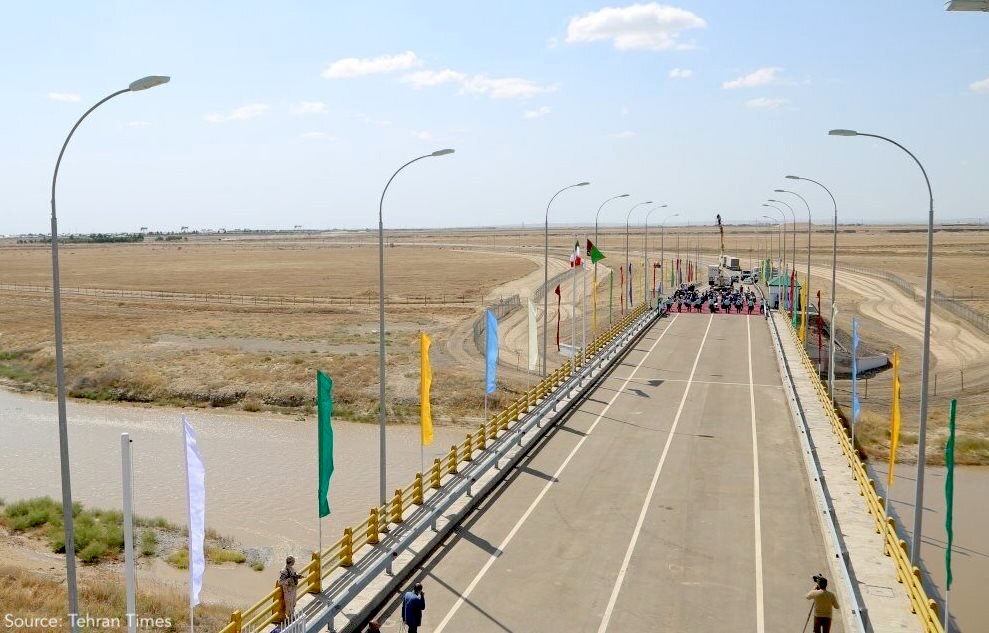
On June 8, two days before the planned border re-opening, the Sarakhs-Sarahs Border Bridge was inaugurated over an online video ceremony. The bridge is located at the Khorasan Razavi province and is 15.1 meters wide and 96 meters long. Iranian Ambassador to Turkmenistan Golam Abbas Arbab Khales referred to this bridge as the “Friendship Bridge” and stressed its importance in fostering growing economic cooperation between Iran and Turkmenistan. Iranian Minister of Roads and Urban Development Mohammad Eslami was also present, alongside the governors of the Razavi Khorasan Province in Iran and the Ahal Province in Turkmenistan. Turkmen Construction and Agriculture Minister Rahim Gandymov was present as well. The two countries plan on using this bridge to exchange goods, and according to Eslami, it is estimated that over 1000 trucks will pass through this commercial bridge daily.
This was first officially announced on May 31, during Khales’ interview with Iranian state news agency IRNA, where he stated that Iran and Turkmenistan planned to re-open their borders on June 10. Khales stressed that border openings would be under strict sanitation restrictions. Sanitation tunnels are planned to be placed at the entrance and exit of each border as a preventive measure. The two countries additionally, announced intentions to re-open their borders not only at the Sarakhs-Sarahs border crossing but at the Incheboron-Gudriolum and Loftabad-Artyk crossings as well.
Eslami, like Khales, views the Sarakhs-Sarahs Border Bridge as a step forward in increasing ties, investment, and cooperation between the two countries. During the inauguration, Eslami stated that he hopes that the border bridge will turn into a “special economic zone” as it was created using the framework of various pre-existing agreements, like the Ashgabat Transit Agreement. He noted that the bridge opening had taken place concurrently with the expansion of various projects of the Economic Cooperation Organization.
Overall, the Sarakhs-Sarahs Border Bridge opening is part of a larger pattern of Iranian-Turkmen economic cooperation, with Iran viewing Turkmenistan as its gateway to the Central Asian states. A major goal of the Iranian government is the export of its revolutionary ideals into – and beyond – the Shia Crescent, gaining economic and political influence. Iran views economic cooperation as the first step towards political cooperation. Moreover, one can look at China’s influence in Central Asia as a paradigm to which Iran aspires. Many of the Central Asian states are indebted to China and, therefore, cannot voice active political opposition to many of China’s policies despite rising anti-Chinese sentiment. One can assume that as a revisionist power, Iran hopes to amass as much power and might as China and views greater economic ties with the Central Asian states as a first step in increasing its influence in the Caspian.